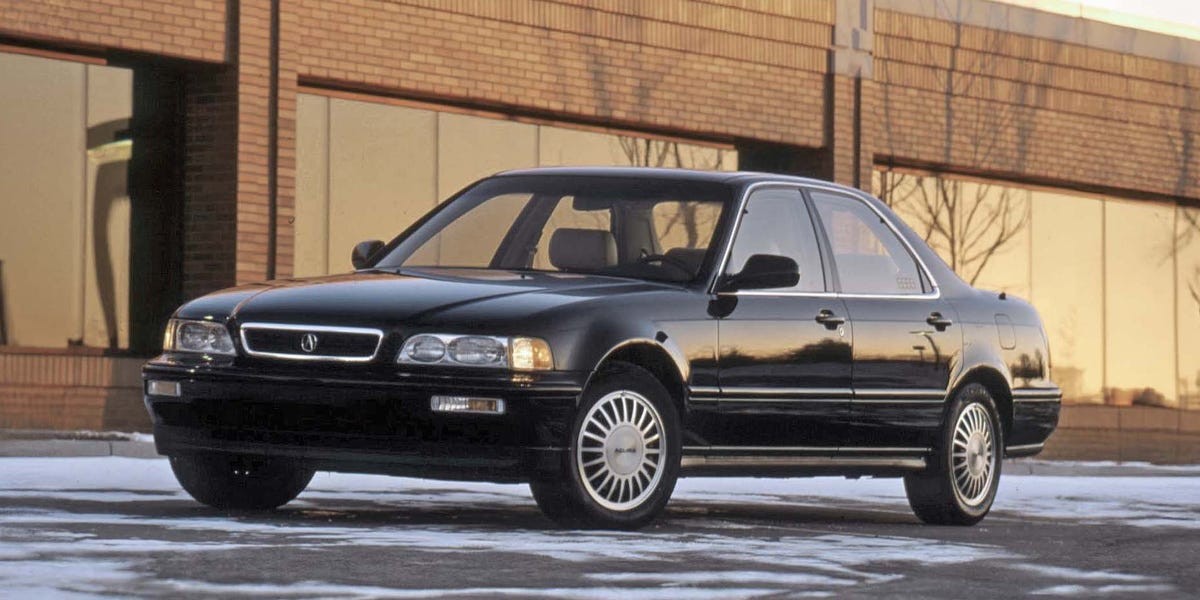
In 1991, Acura faced a critical challenge: how to improve upon a winning formula. The original Legend had been a runaway success, outselling established luxury brands like Mercedes-Benz and BMW in the U.S. market. The redesigned second-generation Legend sedan aimed not just to maintain that momentum, but to raise the bar further – a task that required substantial engineering and design refinements.
A Larger, More Capable Machine
The new Legend was significantly bigger than its predecessor, boasting a 5.9-inch longer wheelbase and an overall increase in length and width. This growth translated into improved interior space, particularly in hip and shoulder room, though rear legroom saw a slight reduction. The expansion wasn’t merely cosmetic; it was a calculated move to directly challenge rivals like the Infiniti Q45 and Lexus LS400, cars that had quickly become benchmarks in the luxury segment. The increased size underscored Acura’s ambition to compete head-to-head with these established players, signaling that the brand was no longer content to simply disrupt the market, but to lead it.
Innovative Powertrain, Enhanced Handling
The most notable engineering change was the adoption of a longitudinally mounted 3.2-liter V-6 engine in a front-wheel-drive configuration. This unconventional setup, while complex, aimed to improve weight distribution from 63/37 to 60/40, enhancing handling dynamics. The engine itself was a powerhouse, delivering 200 horsepower and 210 pound-feet of torque – a substantial upgrade from the previous model’s 160 hp and 162 lb-ft. The result was a noticeable performance boost: the Legend LS accelerated from 0 to 60 mph in just 7.3 seconds, outperforming the Lexus LS400.
This powertrain layout, while initially designed for handling improvements, also fueled speculation about potential future all-wheel-drive variants. The complexity of the system suggested that Honda had deliberately engineered flexibility into the platform, leaving room for further development and expansion. This foresight underscored the brand’s commitment to long-term innovation.
Refined Interior and Advanced Safety Features
The interior received a comprehensive overhaul, though critics noted that it didn’t match the avant-garde designs of competitors like Lexus and Infiniti. Despite this, the cabin offered improved comfort, quality materials, and a range of standard amenities. Notably, the LS trim included dual airbags—a rarity at the time—demonstrating Acura’s commitment to safety leadership. The inclusion of a passenger-side airbag, joining Mercedes-Benz and Porsche in this regard, positioned the Legend as a forward-thinking option in the luxury market.
Performance and Efficiency
On the test track, the Legend proved its mettle. It achieved a top speed of 136 mph and offered improved fuel economy, with an EPA city rating of 19 mpg. While this improvement was modest compared to the Lexus LS400, the Legend’s overall performance remained competitive, delivering a blend of speed and efficiency that appealed to discerning buyers.
Verdict
The 1991 Acura Legend LS was a bold and successful evolution of a proven platform. It addressed shortcomings in handling, increased power, and improved interior refinement, making it a serious contender against the established luxury giants. At a starting price of $26,800 (with the LS trim reaching $34,200), it offered a compelling value proposition for buyers seeking a high-performance, well-equipped luxury sedan. The Legend’s success underscored Acura’s ability to innovate and compete in a fiercely competitive market, solidifying its position as a major player in the automotive industry.