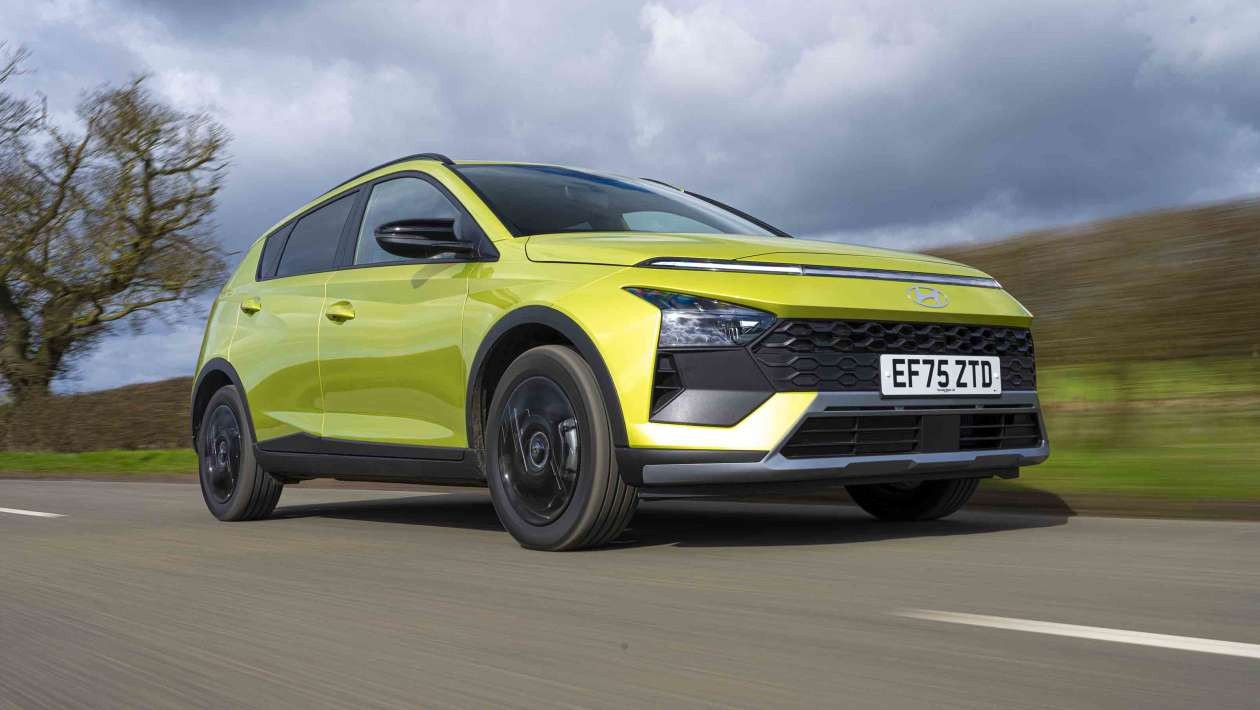
The Hyundai Bayon is a small SUV that often gets overlooked, even within Hyundai’s own lineup. While not a bad car, it doesn’t excel in any particular area, making it a safe, rather than exciting, choice in a competitive class.
Design and Exterior
Hyundai has given the Bayon a distinctive exterior with unusual styling cues – including slim lights, a split grille, and angular bodywork – which were further refined in a 2025 facelift with a new lower grille and rear bumper. Despite its bold looks, the Bayon rides on the same platform as the Hyundai i20 supermini, meaning its underlying technology is fairly conventional.
Engine and Performance
The Bayon is now offered with just one engine option: a 1.0-liter three-cylinder turbocharged petrol engine producing 89 horsepower. A more powerful 118-horsepower version and its mild-hybrid assistance have been discontinued, reducing both efficiency and a small performance boost. Buyers can choose between a six-speed manual or a seven-speed dual-clutch automatic transmission.
Trim Levels and Equipment
Hyundai has simplified the Bayon’s trim range to two versions: Black Line and Tech Line. Both are well-equipped, including standard features like auto main beam LED lights, cruise control, rear parking sensors, dual 10.25-inch screens for infotainment and driver display, a reversing camera, and smartphone connectivity.
Driving Experience
The Bayon offers light controls, making it easy to drive, but its engine feels underpowered. It doesn’t provide an engaging driving experience, with the automatic transmission being particularly slow to shift gears. It’s a competent but largely forgettable driving experience.
Interior and Practicality
The Bayon’s interior is functional but lacks premium materials, with hard plastics dominating the cabin. The infotainment system is decent, with a 10.25-inch touchscreen and digital dials, but the menu structure can be complex. The boot space is adequate but not class-leading, and storage inside the cabin is limited.
Running Costs and Value
The Bayon’s fuel economy is reasonable but slightly worse than before, with the mild-hybrid option now removed. Residual values are average, and it’s not a good choice for company car users due to higher emissions. Prices start around £24,000 for the Black Line version, with an additional £1,500 for the Tech Line.
Conclusion: The Hyundai Bayon is a capable small SUV, but it doesn’t stand out in a crowded market. It offers good value for money and a well-equipped interior, but its underpowered engine and unremarkable driving experience make it a sensible rather than exciting choice.