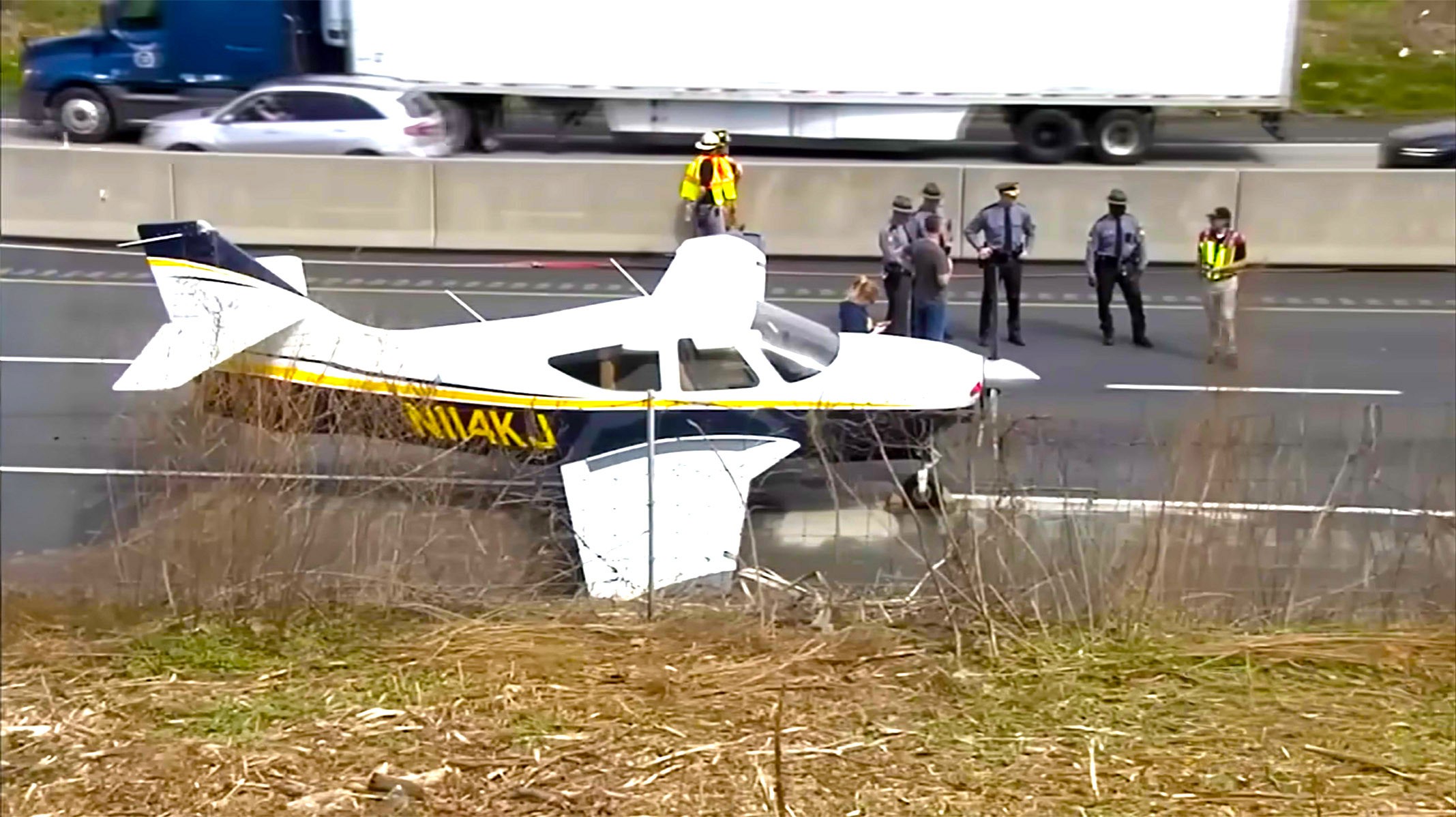
In a scene described by witnesses as “miraculous,” a pilot successfully performed an emergency landing on a busy stretch of Interstate 78 in Lehigh County, Pennsylvania, after experiencing engine failure. Despite the high stakes of landing a light aircraft on a major highway, the pilot managed to avoid all vehicular traffic, resulting in zero injuries to the passengers or motorists.
The Incident on I-78
The emergency unfolded around 9:30 a.m. on Saturday. A 65-year-old pilot from Michigan, accompanied by a 34-year-old passenger from New Jersey, was flying from Solberg Airport in New Jersey toward Indiana. While cruising over Pennsylvania, the pilot reported mechanical issues involving the aircraft’s engine.
While the pilot initially communicated via radio that he hoped to avoid using the highway for his landing, the reality of the mechanical failure left him with no other viable options. He ultimately brought the aircraft down across two eastbound lanes in Weisenberg Township.
Precision Under Pressure
What makes this incident extraordinary is not just the landing itself, but the precision with which it was executed. Witnesses on the scene noted that the pilot maintained remarkable composure during the descent.
- Spatial Accuracy: According to witness Victor Machese, the plane was positioned perfectly between the highway median and the shoulder. Despite the aircraft’s wingspan spanning nearly the full width of two lanes, it did not strike any vehicles.
- Pilot Composure: Observer Chase Galanti noted that the pilot appeared remarkably calm, a factor that likely prevented a much more chaotic outcome.
“It was an Easter miracle,” remarked Machese, reflecting on the narrow margin between a successful landing and a catastrophic collision.
Emergency Response and Aftermath
Local emergency services responded quickly to the scene. While Weisenberg Volunteer Fire Chief Justin Oswald noted that such an event is entirely outside the realm of standard highway operations, the response was coordinated and efficient.
To manage the scene and ensure safety:
– Emergency crews temporarily blocked highway ramps and exits.
– The aircraft was eventually escorted off the interstate.
– The plane was moved to a nearby airport in Allentown for further inspection.
Why This Matters: The Safety Context
While this event ended without tragedy, it highlights the inherent risks of general aviation. Engine failure is one of the most critical emergencies a pilot can face, especially when transitioning from high-altitude flight to a forced landing. The outcome here was heavily dependent on pilot proficiency and rapid decision-making —the ability to identify the “least bad” landing spot in a matter of seconds.
The Federal Aviation Administration (FAA) has launched an investigation into the cause of the engine failure. This investigation will eventually determine whether the issue was due to mechanical fatigue, maintenance errors, or other technical factors, providing vital data to prevent similar occurrences in the future.
The incident serves as a testament to the importance of emergency flight training, as the pilot’s ability to remain calm turned a potentially fatal accident into a controlled, albeit extraordinary, landing.