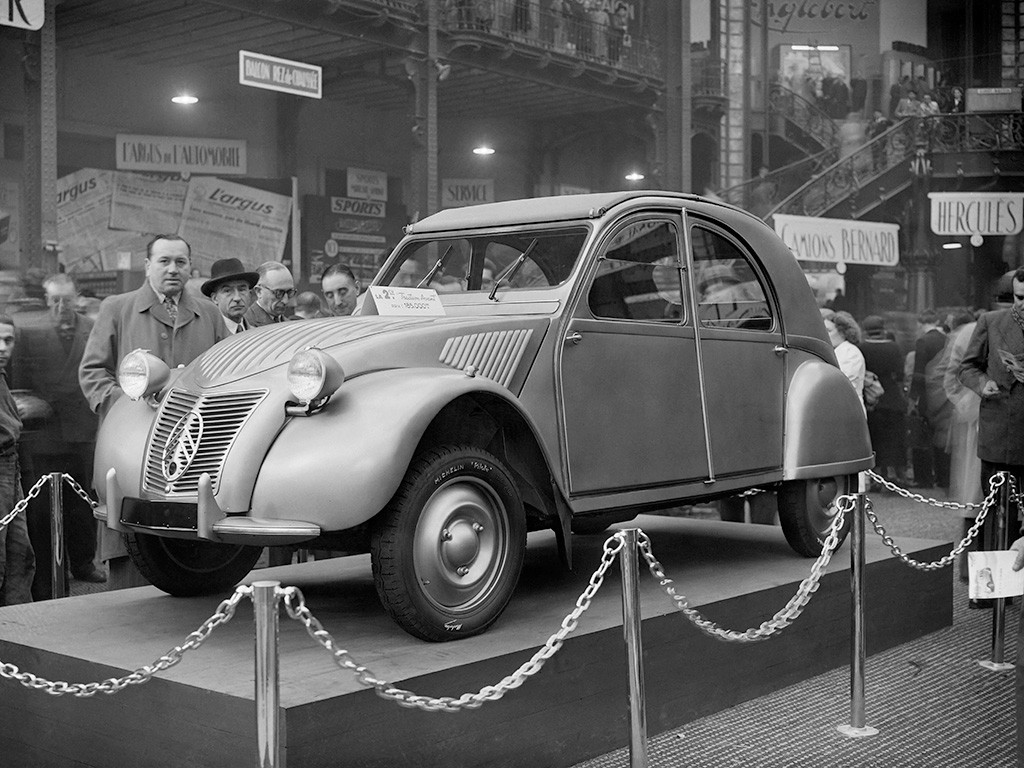
Nearly eight decades ago, at the Paris Motor Show, Citroën introduced a vehicle that would redefine mobility for an entire nation. The Deux Chevaux Vapeur (2CV) was not merely a new model; it was a solution to a social problem. Designed to “put France on wheels,” this tiny, unconventional machine would eventually become a cultural icon and the first car in history to reach the million-unit sales milestone.
A Delayed Vision of Mobility
The journey of the 2CV was anything but smooth. While it debuted in 1948, its origins date back to 1936. Originally conceived as the Toute Petite Voiture (“very small car”), the project was intended to motorize the rural populations of France.
However, the onset of World War II halted progress. The project faced significant hurdles as the German invasion forced developers to hide prototypes from Nazi forces. It was only after the war that Citroën was finally able to bring this vision of affordable transport to the public.
Engineering Simplicity: Function Over Form
To achieve its goal of extreme affordability, the 2CV sacrificed aesthetics for radical engineering. It was a vehicle “simplified to the point of crudity,” characterized by a thin steel body and a canvas roof. Every design choice was driven by the need to reduce weight, lower costs, and maximize production efficiency.
Key technical features included:
– The Chassis: A steel box-frame with a unique suspension system featuring two arms linked to a central spring cylinder.
– The Engine: A modest, air-cooled 375cc flat-twin engine paired with a three-speed gearbox.
– The Interior: Minimalist “seats” consisting of simple cushions held to frames by rubber bands.
– Performance: While its top speed was a modest 37 mph, it compensated with exceptional fuel economy, achieving between 50 and 60 mpg.
This focus on utility allowed Citroën to price the car at just £213 (roughly £5,970 in today’s value), making it significantly cheaper than its primary competitor, the Renault 4CV.
The Post-War Automotive Landscape
The 1948 Paris Motor Show was a snapshot of a world recovering from austerity. While the 2CV captured the imagination of the masses, it competed in a diverse market of post-war designs that offered different visions of the future:
- Ford France’s V8 Vedette: Offered a more “modern” approach to mass production, providing a sense of stability and standard quality.
- Panhard: Introduced a streamlined, four-seater model inspired by aircraft design, showcasing a more aerodynamic aesthetic.
- Peugeot 203: A major highlight of the show, the 203 moved away from traditional chassis construction in favor of a monocoque (unibody) design—a structural trend that would eventually become the industry standard.
- Rovin: Also utilized the monocoque approach for its two-door economy models.
Legacy of an Icon
The 2CV’s success was staggering. It remained in production for over four decades, ending its run in 1990 with approximately nine million units produced. By prioritizing accessibility and mechanical simplicity over luxury, Citroën created more than just a car; they created a tool for social mobility.
The 2CV proved that a vehicle does not need to be beautiful or fast to be revolutionary; it only needs to be attainable.
In summary, the Citroën 2CV succeeded by embracing extreme minimalism to solve the economic challenges of post-war France, ultimately transforming from a budget tool into a global cultural phenomenon.