Toyota is no stranger to mechanical innovation, but its latest venture moves well beyond the assembly line. The automaker, which originally began as a manufacturer of automatic looms in the 1920s before transitioning to cars in 1934, has turned its engineering prowess toward robotics. In 2026, Toyota unveiled CUE7, a humanoid robot capable of dribbling, moving freely, and shooting baskets with human-like precision. This development marks a significant leap in the company’s long-running CUE Project, demonstrating how automotive engineering principles are being applied to complex, dynamic human interactions.
From Looms to Layups: The Evolution of CUE
The CUE Project, launched in 2017, is a volunteer-driven initiative by Toyota’s Engineering Society. Its primary goal is to develop artificial intelligence from scratch, using basketball as a testing ground for motion control and decision-making. The project has already achieved notable milestones, including two Guinness World Records:
- 2019: CUE set the record for the most successive free throws by a humanoid robot (assisted), making 2,020 consecutive shots.
- 2024: CUE6 achieved the longest shot by a humanoid robot, launching the ball 24.55 meters (80.5 feet).
These early achievements focused on static accuracy and power. CUE7, however, represents a “full model change,” shifting the focus from stationary shooting to dynamic, on-court performance.
Engineering a Humanoid Athlete
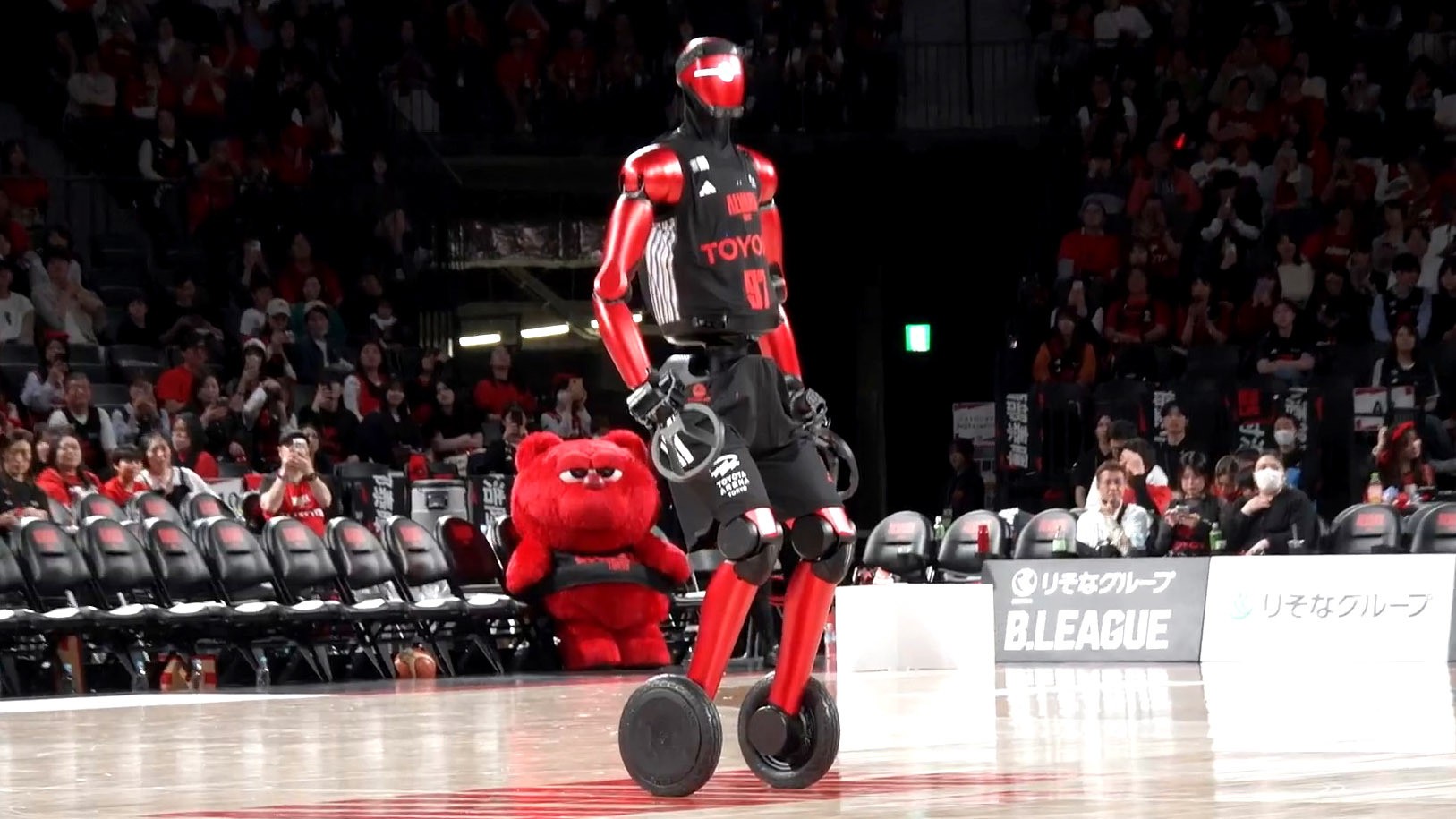
CUE7 debuted at an Alvark Tokyo home game at the Toyota Arena in Tokyo, showcasing its capabilities in a live, high-energy environment. Standing 7 feet 2 inches (2.18 meters) tall and weighing 163 pounds (74 kg), the robot balances on two wheels and wears a black Toyota-branded outfit.
The robot is equipped with an array of cameras and sensors that allow it to analyze its environment in real-time. This data enables CUE7 to determine the precise force and trajectory needed to manipulate the ball, whether dribbling or shooting. While the estimated cost of $150,000 per unit suggests this is currently a specialized prototype rather than a consumer product, it highlights the sophistication of Toyota’s sensor integration and AI processing.
Why This Matters
The significance of CUE7 lies not just in its ability to play basketball, but in what it reveals about the future of robotics. By mastering the unpredictable physics of a bouncing ball and the spatial awareness required for court navigation, Toyota is solving complex problems in real-time AI decision-making and dynamic balance. These are critical technologies for future applications in logistics, healthcare, and disaster response, where robots must operate in unstructured, human-centric environments.
The imperfections in CUE7’s performance may actually be a feature rather than a bug. These “human-like” errors provide valuable data for refining AI learning algorithms, making the robot more adaptable and relatable.
Conclusion
Toyota’s CUE7 is more than a novelty act; it is a tangible demonstration of the company’s expanding expertise in AI and robotics. By leveraging its history of engineering excellence, Toyota is pushing the boundaries of what humanoid robots can do in dynamic settings, paving the way for more sophisticated and versatile machines in the future.