Off-roading asks for a lot. Long travel suspension. High clearance. An engine that pulls at the bottom end rather than screaming at the top. Purpose-built dirt bikes do this well. They also demand race-week maintenance and fail every street law inspection.
You want one machine for all roads? You have to choose. Do you buy a beast that needs the mechanic every few weeks or a simple bike that quits when the dirt gets serious? The dual-sport tries to walk the line.
What Buyers Actually Want
Service intervals. This is where old-school dual-sport logic fails. Historically based on motocross engines these bikes demand attention measured in hours not miles. They are tough sure. But if you ride year-round commuting on weekdays and hiking on weekends those hours add up fast.
An oil change schedule calibrated for the street matters. The Honda CRF450R L? Great bike. Essentially a race machine with turn signals. It wants your attention. A bike built for longevity shouldn’t.
Parts matter too. A platform produced for ten years means shops know it. Wear items stay cheap. The more analog the machine the more likely it is to survive ten thousand miles without a breakdown.
Suspension separates the category. Ten inches of travel on a light chassis behaves nothing like ten inches on a heavy adventure tourer. Power delivery counts. Run out of torque below six grand and you spend the trail shifting. You should be watching the rocks.
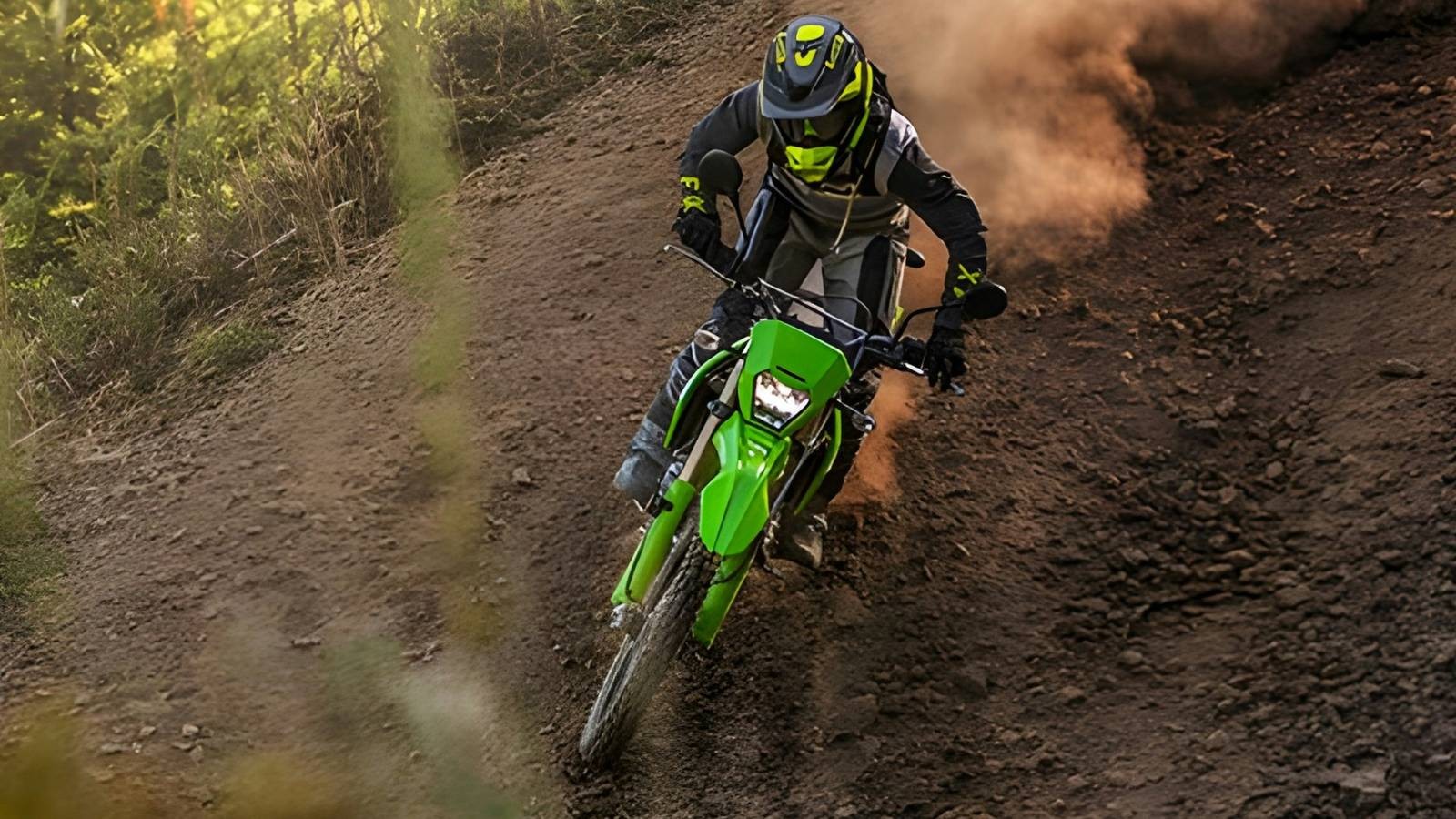
The 2026 Kawazu KLX300
Kawasaki introduced this in 2021. They updated it in 2024 by leaning hard on their enduro DNA rather than just slapping off-road bits on a street engine. The result is tough. Five years of production have built a deep ecosystem of parts even in independent shops.
Pricing helps too. Lime Green hits $5649. Bright White sits at $5449. That’s $100 to $3 leave0 less than the comparable Honda CRF300 L. The gap grows if you count suspension tweaks.
An Engine That Won’t Die
292 cc single. Liquid-cooled. DOHC. It pushes through a 34 mm throttle body and makes 25 horsepower. Torque hits 18.1 lbs-ft. Numbers average the segment. The engineering saves you.
Liquid cooling manages heat. Traffic jams or slow crawl speeds won’t cook it. The six-speed box has a return-shift clutch. Ratios stay usable in technical stuff. No electronics help this. Fewer systems to break means a better track record. Kawasaki designed this for the grind not the podium sprint.
Simpler means reliable. Always has. Always will.
Steel Frame And Shock Adjustment
Reliability needs a good chassis. Kawasaki uses a box-and-tube high-tensile frame. The engine acts as a stressed member. Rake is 26.7 degrees. Wheelbase 56.7 inches. Ground clearance sits at 10.8 inches. Heavy adventure bikes catch their unders on roots here. You won’t.
The suspension sets it apart. The front fork is a 43 mm inverted cartridge unit. Ten inches of travel. Compression damping adjusts. Not just preload. This price rarely offers that.
The rear shock belongs to Uni-Trak. Nine-point-one inches of travel. You adjust compression rebound and preload. No special tools required.
Light And Upright
It weighs 302 pounds wet. That feels lighter than competitors. Seat height is 35.2 inches. High enough for trails. Kawasaki data shows beginners buy few of these. Most riders have twenty years under their belts. The weight suits veterans who lift bikes frequently.
Footpegs sit mid-frame. Stance is upright. Weight spreads evenly. A radiator fan blows heat away from your shins. This solves a common complaint against liquid-cooled singles. The tank is the flaw.
Two point one gallons only. Range hits about eighty miles. Maybe a hundred if you ease up. Is it enough for cross-state touring? Probably not. For trail riding with some street transitions? It works.
Handling The Small Stuff
That 56.7 inch wheelbase and clearance let it dance on narrow singletrack. Heavier dual-sports require constant body movement. This bike flows. It out-handles the lighter KLX 230 Sherpa which is only two pounds less. The frame holds lines through loose corners without twitching. A 21-inch front wheel eats bumps.
Versus The Rest
The Honda CRF 300 L costs $5749. Same displacement. Six speed. Ten point two inches of front travel. The rear shock differs though. Honda only allows preload adjustment. Kawasaki gives full three-way adjustability on the back end.
Then there is the KTM 390 enduro R. Priced at $6049. Bigger engine. TFT display. Ride modes. It performs better. It costs more. It breaks the “low friction” ownership rule. For riders who want simplicity and budget the KLX 300 wins on adjustability and entry price. Electronics cannot replace durability without adding points of failure.
The market shifts toward complexity every year. Sometimes the answer is just less. Less wiring. Less weight. Less maintenance. Does that matter to you? It might.