Adventure touring sounds simpler in theory. It’s supposed to be about leaving the pavement behind and ignoring cell service. In practice? The category has evolved into a showroom of electronic wizardry. We’re talking semi-active suspension, cornering ABS, and ride-by-wire throttles on machines that cost as much as a compact sedan.
It’s capability, sure. But it’s complicated.
When you buy into the modern adventure bike ecosystem, you aren’t just buying a motorcycle. You are buying into an expensive maintenance schedule. The Yamaha Ténéré 700 sits at $10,999. The KTM 890 Adventure R jumps to $16,299. Add luggage. Add armor. Add a GPS, tools, and gear that doesn’t fall apart in the rain, and you are easily looking at a $15k to $18k+ investment.
Does that make sense for the average rider who spends 90% of their time on asphalt and gravel? Maybe. Maybe not.
This is where the Kawasaki KLR650 stops making sense to enthusiasts, but makes perfect sense for travelers.
The Budget Adventure Bike That Defies Trends
Let’s look at the math. The current Kawasaki KLR650 starts at a staggering $6,999. That’s roughly $4,000 less than a Ténéré and nearly $9,300 shy of a top-spec KTM.
It’s a liquid-cooled, fuel-injected, single-cylinder 652cc thumper. No horsepower numbers are published by Kawasaki. Who needs them? The KLR doesn’t race. It arrives.
The specs look dated. A tubular semi-double-cradle frame. 41mm forks with 7.9 inches of travel. A Uni-Trak rear shock with preload and rebound adjustment. 21-inch front wheel, 17-inch rear. Tube-type tires. Disc brakes up front and back. ABS is optional on the base model.
The dashboard? Basic digital. No TFT screen. No traction control. No quickshifter. No smartphone integration to distract you from the road.
But here’s what it does have.
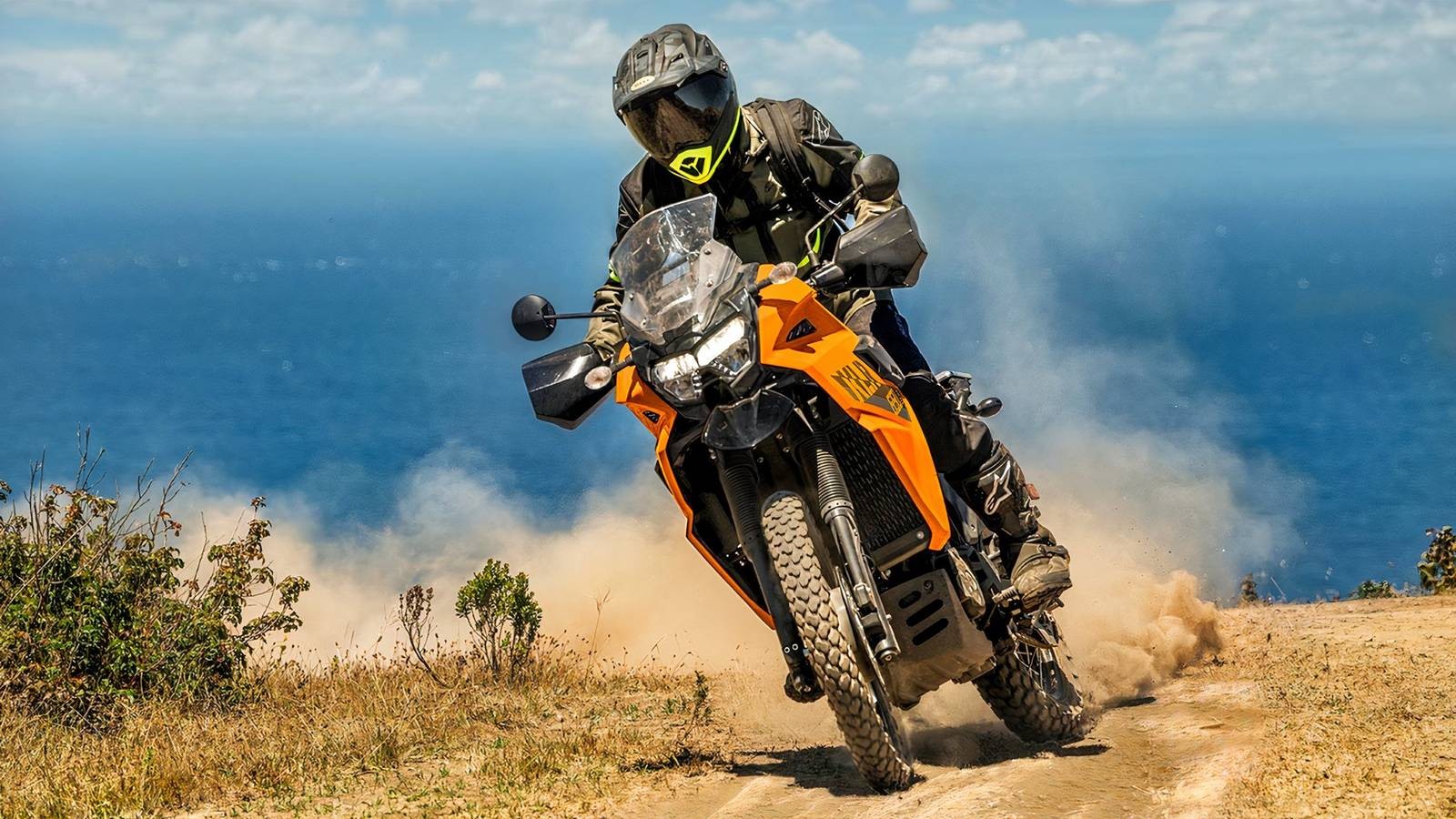
A large adjustable windscreen, sturdy hand guards, an aluminum rear carrier, and a generator rated to power your heated gear.
It’s an upright, comfortable riding position built for fatigue reduction, not podium finishes. It’s a machine designed to ask questions later.
Is The Kawasaki KLR650 Good For Off-Roading?
Short answer: Yes, if you know how to ride.
Long answer: It’s heavy.
The non-ABS base model tips the scales at 456.2 lbs ready to ride. Add ABS, and you’re pushing 460.6 lbs. The Adventure trim, loaded with factory cases, LED lights, and engine guards, balloons to 487.1 lbs.
That mass is a double-edged sword. On a single-track trail, when that single-cylinder engine drops to the left side in deep sand or mud, lifting it back up is a workout. The five-speed transmission feels cramped on sustained highway stretches. The non-switchable ABS can be less forgiving in loose terrain than the sophisticated setups on pricier bikes.
But weight isn’t always the enemy. Once loaded with camping gear, water, and tools, the difference in ride height and handling between the KLR and lighter rivals diminishes. The 60.6-inch wheelbase and 30-degree rake provide highway stability. It won’t dance. It plods. Like a farm tractor with license plates.
And when crosswinds hit? Or broken pavement? That mass keeps it settled.
Why The KLR650 Is Known For Reliability And Low Maintenance
Since 1987. Three generations. The same formula.
Simple mechanics. Undersressed engine components. No complex electronics to fail.
This isn’t a myth. Check ADVRider. Check Reddit. Check KLR.net.
You will find stories of owners pushing these bikes past 60,000 and 70,000 miles. We found a verified example with 172,000+ miles on the clock.
Why? Because the design is open. Any mechanic who has worked on a truck or a tuk-tuk can diagnose and fix most issues. You don’t need a dealership. You don’t need proprietary diagnostic tools. You don’t need software updates.
Just a wrench, a service manual, and some time.
This reliability has a pedigree. Dr. Gregory W. Frazier used a KLR650 to circumnavigate the globe in 2001-2002. In 2017, four veterans attempted the Darien Gap on them. One of the most unforgiving places on Earth. They made it.
Where Does The KLR650 Excel For Overlanding?
Range.
The 6.1-gallon tank is the secret weapon. Depending on load and terrain, you can expect around 300 miles per tank. In rural areas where gas stations are sparse or nonexistent, that range is invaluable. It changes the equation of where you can go. You aren’t tied to a map of fuel stops. You have freedom.
Combine that range with the broad saddle, fairing, and relaxed ergonomics, and fatigue drops. You can ride longer.
And what do you do with the money you didn’t spend on the bike?
The Financial Advantage Of Choosing The Kawasaki KLR650 For Travel
If you buy the Ténéré, you have $4,000 in your pocket compared to buying the KLR. If you buy the KTM, you have $9,300.
That money isn’t theoretical. It buys:
* High-quality luggage and crash protection.
* Upgraded suspension components.
* Better tires for specific terrain.
* Weeks of food and lodging.
You aren’t just buying a bike. You are buying the adventure.
The KLR leaves room in the budget for the experience itself. It allows you to upgrade the machine to your needs rather than being locked into a dealer’s package. You can fix it yourself. You can learn from it.
Final Thoughts
The KLR650 isn’t the fastest adventure bike. It isn’t the lightest. It doesn’t have the sharpest electronics.
But it’s reliable. It’s affordable. And it’s versatile.
It handles commuting, camping, touring, and light off-roading with equal indifference. It’s a tool, not a toy. And for riders who view their motorcycle as a means to an end, rather than the end itself, that distinction is everything.
It’s not about having the best bike on paper. It’s about having the bike that gets you home, and gets you out again.