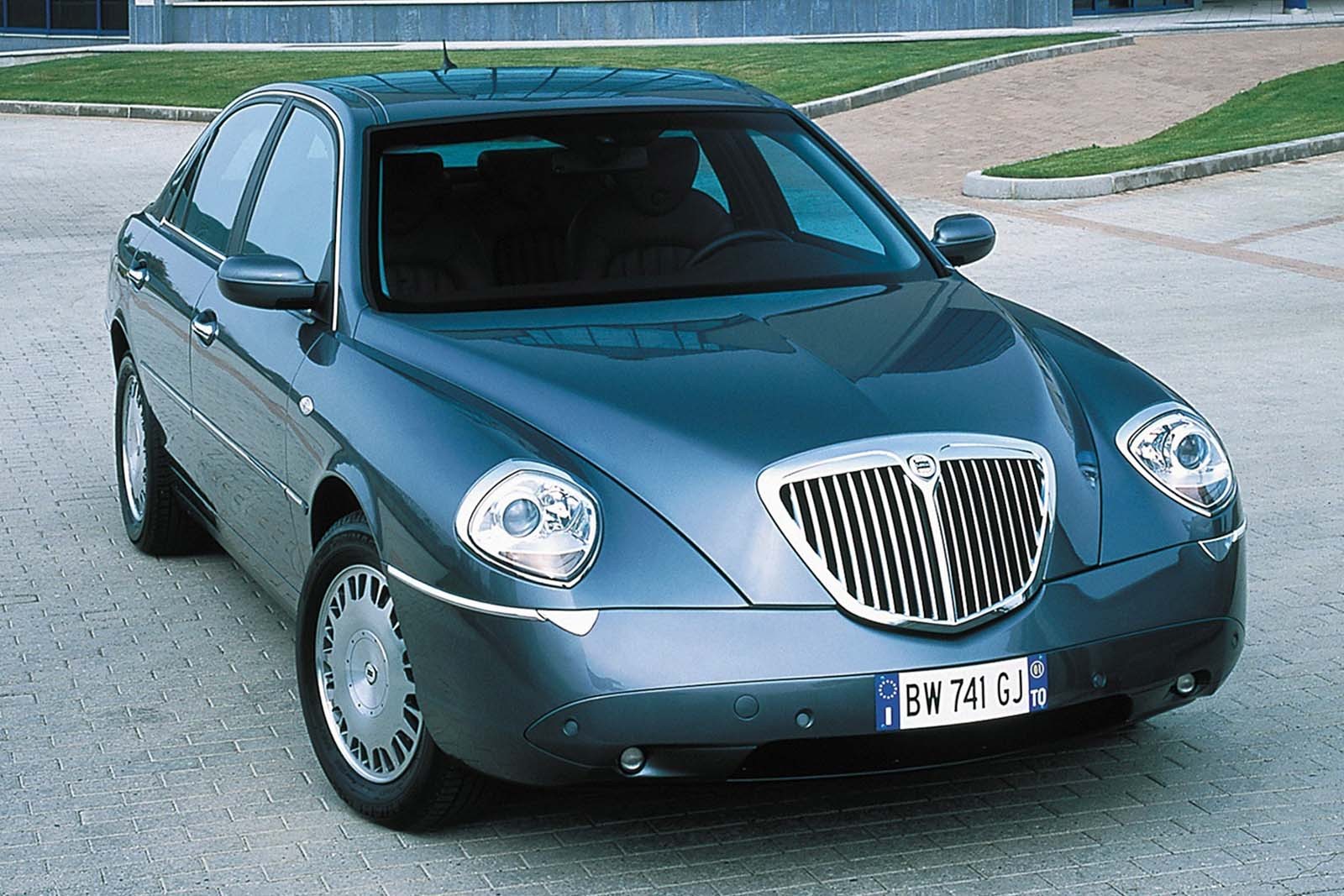
Lancia poured money and engineering time into the Thesis. They wanted a serious competitor. A direct rival to the BMW 5 Series and the Mercedes E-Class.
It didn’t work.
Few Lancia cars ever got such resources. This one sat on a bespoke chassis. It used the same suspension as the Maserati GranTurismo and Quattroporte. It had radar-guided cruise control. The first Lancia to feature it.
Yet sales never took off. Under 20,000 units rolled off the line in eight years. It was never sold in the UK. Even in Italy, spotting one feels lucky.
Why did a car with such pedigree disappear so quietly?
A Compromised Design Legacy
The front looks like a medieval shield. Chrome grille, bold stance. The rear features gothic, translucent tail lights that glow strangely. Distinctive, sure. But look at the side profile.
It’s a car of three unrelated parts. The nose is bold. The tail is weird. The middle? Dull. The dullest center section of any executive car on the market.
This banality hurts because of where it came from.
The Thesis (pronounced tay-sis ) started as the 1998 Dialogos concept. That concept was striking. Clean flanks. A wooden floor. Suicide rear doors. A subtly sculpted dashboard. It promised something new.
Lancia lost its nerve.
The production version traded the Dialogos’ curvy elegance for straight lines. Safe lines. Boring lines. Given that the Thesis barely registered on sales charts against the Audi A6 or E-Class, why not go further? Why not produce something actually different?
The Thesis feels pretty special inside… despite the loss of the concept’s smooth-contoured seating.
Luxury Inside, Flimsiness Outside
The interior tries to redeem the exterior. Wood trim is used sparingly. Instruments have cream faces. The seats are richly upholstered. You can get heated, cooled, and massaging seats. Front and rear.
It’s a cabin you want to sit in.
But the experience falls apart at highway speeds. Or rather, on highway joints.
The Fiat Auto group had a habit in those years. Their cars struggled to absorb sharp transverse ridges. Expansion strips on motorways would send judders through the dashboard. A creaky, plastic-shaking tremor.
I wanted to see if the Thesis avoided this.
It didn’t.
Within minutes of driving at Turin airport, it hit an autostrada expansion joint. I heard the dashboard quiver. A faint plastic crack. The suspension, despite its Maserati roots, failed to suppress the tremor.
It felt mild. It felt flimsy.
Is a dashboard rattle really the end of a car? Maybe. But it broke the illusion. The Thesis looked expensive. It drove apart.