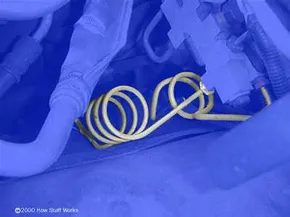
You look at the brake lines under your car and think the engineer lost it. Those bends? Those loops? They aren’t random. They’re there to save your life.
Cars aren’t rigid boxes. They twist. They flex. They breathe.
Trucks are the worst offenders. The body sits on rubber mounts bolted to the frame. When you hit a bump, the body moves relative to the frame. The master cylinder is bolted to the body. The brake calipers? Often bolted to the frame or suspension components that move independently. Step on the pedal. You flex the firewall. The master cylinder shifts. The rest of the system stays put.
If you connected those points with a straight, taut line of steel, it would snap.
Metal fatigue is real. Bend a spoon back and forth enough times and it breaks. Do that to a brake line every time you drive over a pothole and you’re looking at catastrophic failure. The coils act like springs. They absorb that movement. The strain on any single section of the pipe stays low.
It’s not just about physics. It’s about manufacturing tolerances.
No two cars are built with perfect, atomic-level precision. The distance from the master cylinder to the ABS pump varies. Even slightly. Those extra inches of coiled line give the assembly line workers some wiggle room. You don’t need a custom-fit line for every vehicle. You need one that works for all of them.
So yeah. The spaghetti looks messy. But it’s the only reason your brakes work when you’re driving off-road or just sitting in traffic.
How do brake lines handle chassis flex?
The answer is geometry. By turning a straight path into a series of loops, you distribute the stress. Instead of one point taking the full brunt of the chassis movement, the motion is spread across the entire coil. The metal doesn’t have to stretch or compress significantly. It just shifts shape slightly.
This matters most in vehicles with body-on-frame construction, like pickups and SUVs, but it’s relevant for unibody cars too. The firewall flexes when you brake hard. The master cylinder moves. The lines accommodate that shift.
Why aren’t brake lines just straight pipes?
Straight pipes are stiff. They transfer force directly. In a braking system, you want pressure transfer, not structural rigidity between moving parts. If the line were straight, the car’s natural flex would pull on the fittings. Threads strip. Seals blow. Lines crack.
The loops provide flexibility without adding length to the fluid path significantly. The hydraulic pressure still travels efficiently. But the physical connection can bend with the car.
What happens if brake lines fail due to flex?
Usually, it starts with a leak. A tiny crack in the metal or a seal at a fitting gives way under constant stress. You lose pressure. The pedal goes soft. Then it goes to the floor.
It’s a gradual process until it isn’t. The metal fatigues over thousands of miles of driving. The loops delay this fatigue. They extend the life of the line by keeping the stress levels low.
The coil design ensures that flexing in any one section is minimal, putting almost no strain on the line.
Do all cars use coiled brake lines?
Essentially, yes.