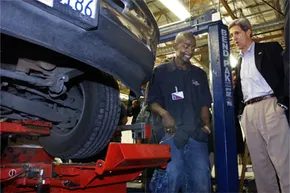
Start with the rubber. Look at your tires. If the outer edges are shredded while the inner treads look relatively new, you are likely dealing with poor alignment. Uneven tire wear is the smoking gun. It is the most common sign that your wheels are pointing in the wrong direction.
There are other symptoms. Your vehicle might drift to one side even when you are trying to drive straight. The steering wheel could vibrate under your hands. Or, you might be driving perfectly straight down the highway but find the steering wheel is off-center. It is tilted to the left or right. These are clear indicators.
If you do not see these signs, check your owner’s manual. Manufacturers often specify a mileage interval for this service. Adhere to it.
Alignment issues are a normal part of car ownership. The word “alignment” is misleading. It does not refer to the wheels themselves. It refers to the suspension. Driving wears out suspension parts. Springs stretch. Control arms loosen. Hitting a curb or a small pothole can knock these highly calibrated components off-kilter. The wheels end up sitting at improper angles. An alignment corrects these angles. It brings everything back to factory specifications.
The financial benefit is obvious. Tires are expensive. You pay $100 or more per tire. An alignment often costs between $50 and $150. It is a cost-effective way to extend the life of your tires. When your suspension is properly aligned, tires wear evenly. You get more miles out of every set.
Safety and efficiency also improve. Your car will handle better. It will drive straight without constant correction. Fuel economy increases too. Properly aligned tires create less rolling resistance. The engine does not have to work as hard to push the car forward.
In the next section, we will break down exactly what mechanics do during the process.
What Happens During an Alignment?
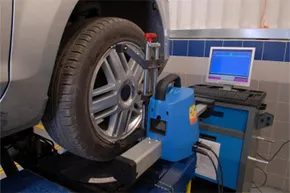

A wheel alignment isn’t just a quick tweak. It is an elaborate mechanical process that reconfigures your suspension geometry. The goal is simple: position the wheels so they are parallel to each other and perpendicular to the road surface. You need an experienced mechanic for this. They use specialized alignment machines to get the specs right.
Modern equipment uses clamp-like devices attached to each wheel. The car is raised on a lift. These clamps link to a computer that makes precise measurements. While the machine does the math, the mechanic inspects the hardware. They look for worn or broken suspension components. If a part is shot, no amount of adjustment will fix the alignment.
The Core Angles
Essentially, you are squaring the wheels and axles. They must move in the same direction. The technician adjusts specific suspension angles. These influence tire movement and position.
- Toe : This refers to how much the tires point inward or outward when viewed from above.
- Camber : The tilt of the tire when viewed from the front or rear. Positive camber tilts out; negative tilts in.
- Caster : The angle of the steering pivot axis when viewed from the side.
- Thrust : The direction the rear axle points relative to the vehicle’s centerline.
The technician ensures the steering wheel stays centered during this process. If the wheel is crooked when the car drives straight, something is off.
Manufacturer Specs vs. Performance Tuning
Every car manufacturer sets standard angles. These are specified in degrees. Stick to these specs for daily driving.
But what if you drive a high-performance machine?
You might ask for a performance alignment. Your mechanic can adjust the suspension to improve handling and tire performance. This often means more negative camber for cornering grip. But there is a trade-off. This aggressive setup can lead to uneven tire wear. The tires might scrub against the pavement more heavily on the inside edges. It is a choice between grip and longevity.
Front-End vs. Four-Wheel Alignment
Which service does your vehicle actually need? It depends on the suspension.
A four-wheel alignment is for all-wheel drive vehicles or front-wheel drive cars with independent or adjustable rear suspensions. In this case, both axles must be aligned. The goal is to make all four wheels align in a rectangle. They must be parallel to one another and perpendicular to the ground. If the rear wheels are out of whack, the front tires will fight against the rear. The car will “dog-track” down the road.
Most cars only require a front-end alignment. This applies to solid rear axle vehicles. Here, only the front-axle components are adjusted. However, the mechanic still checks the thrust angle. This is the angle the rear wheels point relative to the car’s center. If the rear axle is misaligned, the mechanic realigns the rear wheels. They must be parallel with the front axle and perpendicular to the car’s center line. Otherwise, the front tires will constantly correct for the rear drift.
Proof in the Printout
When the job is done, do not just drive off. Ask for a printout.
You want to see before and after images of the suspension alignment. This data proves the angles are within spec. It also gives you a baseline for future checks. Without it, you are flying blind.
Load Considerations
How you load the car matters. If you regularly transport equipment or heavy cargo, put a typical load in the car when it is being aligned. The suspension compresses under weight. The angles change. If you align an empty car but load it fully every day, the alignment will be wrong once the trunk is full.
For most drivers, though, the vehicle should be relatively empty during the service. Remove extra weight from the back seat or cargo area. Keep it standard.
The numbers on the printout might look like gibberish to you. But those degrees are what keep your tires from eating themselves alive. Or they might be the difference between a clean lap time and a slide into the guardrail. It’s not magic. It’s just geometry. And geometry doesn’t care how fast you drive. It just cares if the angles are right.