Tech eats everything now. Speed, convenience, safety—promises they all share the same flavor. Most automakers are feeding this beast without blinking, shoving screens and silicon into every crevice available. Volvo is no stranger to the table. With the 2027 EX60 SUV, they’re telling us this is the start of their software-defined era. A digital promise wrapped in metal.
A Computer On Steroids
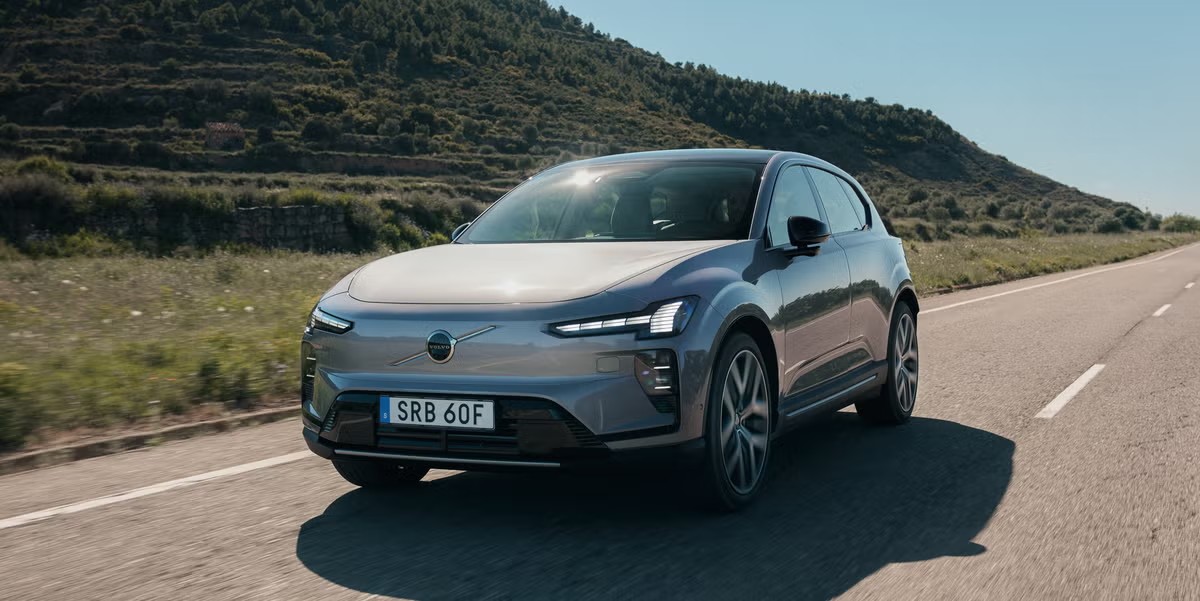
We drove the new two-row SUV through Spain, near Barcelona. It isn’t just an electric cousin to the gas XC60. Think of it as a showroom for their new digital soul. They call it the HuginCore system. A central nervous system built with help from Google, Nvidia, and Qualcomm. The result? Over-the-air updates that actually mean something. Plus, an active-safety suite that knows you better than your last partner.
Underneath the hype is the SPA3 platform. 800 volts running through its veins. It wants to charge faster. It wants to use energy smarter. To make that work, the battery cells aren’t just sitting in the floor; they are part of the structure. Aluminum megacastings replace a hundred little parts in the rear. Lighter. Tighter. Efficient.
By this summer, it hits the U.S. It lands right in the thick of things—facing off against the Audi Q6 e-tron, the BMW iX3, the Mercedes-Benz GLC Electric.
Here’s the lineup:
- P6: The starter. Single motor. Rear-wheel drive. 369 hp. An 80-kWh pack charging up to 320 kW.
- P10: Dual motors. All-wheel drive. 503 hp. A 91-kWh pack hitting 370 kW—if you can find a plug that powerful.
- P12: Coming later this year. 670 hp. 112-kWh beast.
- Cross Country: Rugged versions of the P10 and P12. Arriving as 2028 models.
Volvo claims ten minutes gives you back 160 miles. Eighteen minutes to get from 10 to 8 percent? Standard NACS ports make Tesla Superchargers a simple handshake. Range? Depends on how many rims you want to buy. 20 to 22 inches changes the game. P6 tops out around 307 miles. P10 nudges 322.
Scandinavian Tech Lounge
It’s longer than the XC60 by nearly four inches. Wheelbase grew over four inches. Legroom is comparable upfront, though the gas model still holds a slight edge in the back. The EV feels roomier, mostly because the floor is lower. Headroom benefits.
Cargo space? 20 cubic feet. Toss in the underfloor bin, the little frunk up front, fold the seats, and you’ve got 58 cubes of space.
The interior screams quiet luxury. Fabric on the dash. Texture where you touch. Warmth against the industrial cold. A standard glass roof, dimmable if you pay for the electrochromic option, floods the cabin with light. The seats? Supportive. Your back might actually thank you.
But then you look at the tech. A 15-inch OLED screen runs on Android. It’s fast. Sensible. A massive jump from the confusing messes of older Volvos. Too bad they bolted Google’s Gemini AI to it. A chatbot that lives to listen. Useful? Occasionally. Creepy? Also occasionally. Who needs a robot friend answering your queries from the passenger seat?
Then there are the missing buttons. Physical ones. The climate controls live in the screen. Adjusting the HVAC vents requires digging into menus. Mirror adjustments? Touchscreen again. The steering wheel has some buttons, sure. A scrolling knob for volume adds a nice click. But trying to warm up while driving? You’re hunting for touch targets. It’s annoying. We like buttons. Buttons work when you’re distracted.
Fast, Quiet, Expensive Enough
Drive it on smooth roads and the noise vanishes. It’s isolating. Refined. Our route in Spain was perfect asphalt. Real-world potholes? We haven’t tested those yet. So take the comfort report with a grain of salt.
Suspension varies by model. The P6 rides on passive dampers. The P10 gets adaptive ones. Three firmness settings, though you’d need a laser level to feel the difference between them. Both handle with taut compliance. It stays flat. The heavy battery packs keep it planted, like a stubborn weed rooting into concrete.
Steering is light. The wheel itself is oddly shaped, almost oval, and tiny. It twirls. Switching to a higher effort mode doesn’t save it. It feels remote. Detached. Like the car knows more about the road than you do.
Power is the redeeming feature. The P6 launches in a likely 5.7 seconds to 60 mph. The P10 drops to 4.4 seconds. You won’t get left at lights. On the highway, the P10 will happily chase its 112 mph limiter if you let it. Regen braking is strong. One-pedal driving is viable. We barely touched the brakes. When we did, the friction felt natural. No jerking. Just stopping.
The best part? Price.
The P6 starts at $59,795. It undercuts the plug-in XC60 hybrid. It undercuts most of the German rivals. The P10 is only $2,350 more for the extra power and range. Why save money on a weaker car when the upgrade is so cheap?
Base Plus trim gets you the tech. Want Nappa leather? The Ultra trim. That brings the Bowers & Wilkins sound system—28 speakers, Dolby Atmos. It’s a wall of sound. It costs several thousand more.
Volvo has polarized some people with its modern look. They’ve alienated others with the AI. But the package holds together. It drives well. It looks right. It’s expensive, but maybe worth it. The future is here. It has a 15-inch screen. It has an AI that talks too much. And it still feels like a Volvo.