The EV Landscape Shifts
The American EV market is changing fast in 2026. Forget what pundits predicted two years ago about total saturation. They were wrong.
Interest rates stayed high. Federal tax credits fluctuate like a dice roll. Charging infrastructure still has gaping holes. Daily commuters struggle when they can’t find a plug. Prices for mainstream electric cars remain out of reach for most households. Automakers sit on inventory. Unsold electric trucks and luxury SUVs gather dust.
How do manufacturers adapt? They pivot.
The wealthy don’t need a second daily driver. They need a statement piece for the gates of their coastal compound.
Who Is This Actually For?
Regulatory pressures are forcing brands to rethink their playbooks. Mass adoption is stalled. But the ultra-wealthy? They see EVs as lifestyle accessories.
They already own big trucks for hauling and long-distance travel. Now they want small. Efficient. Quirky.
Enter Fiat.
The Italian brand has been trying to find its footing in the U.S. since 1908. It paused in 1983. It returned in 2011 riding the 500. Now part of the Stellantis family, Fiat leverages shared tech to push full electrification without paying full development costs. In 2026 it’s a niche player in a massive corporate portfolio.
And the new niche is this:
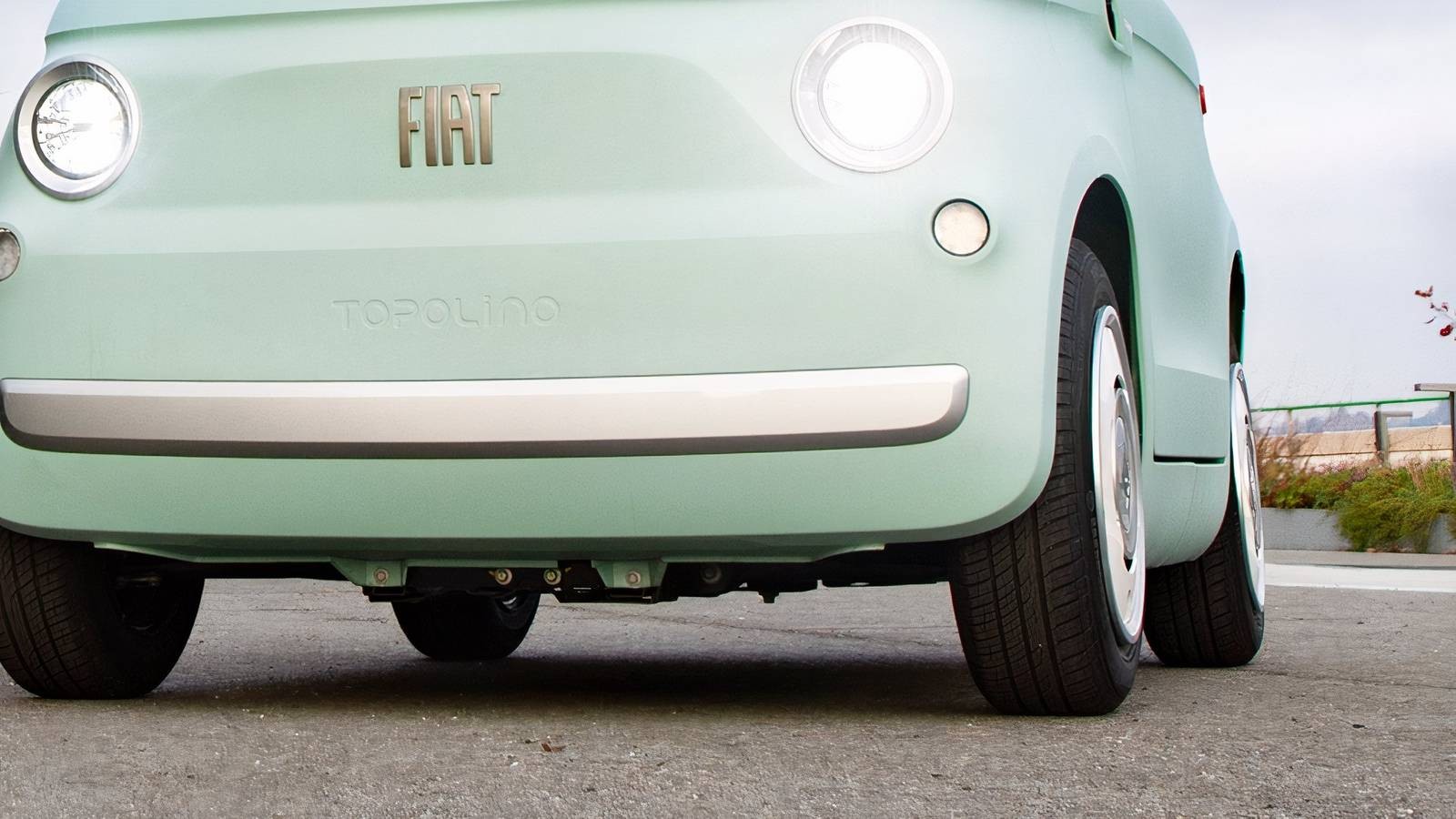
The Fiat Topolino.
Enter The Micro
The Topolino arrives to complement the 500e. It’s not a car in the traditional sense. It’s a quadricycle. Built for private communities. Resorts. Gated neighborhoods.
Production happens in Kenitra, Morocco.
Price? $13,995 for the base model before fees.
Two styles:
- Standard with solid doors and a glass roof.
- Dolce Vita with rope door straps and a roll-back canvas top.
You only get one color. Verde Vita. A specific shade of pastel green. The interior matches. If you want to drive this thing on actual public streets, buy the low-speed vehicle conversion kit. That bumps the price to $14,985.
Simple. Effective. Minimal choices.
The Guts Are Barely There
Rear-wheel drive. A single electric motor. Eight horsepower.
Did you catch that?
Eight. Horse. Power.
It’s underpowered by every conventional metric. But the torque delivery is instant from a standstill. You’ll hit 19 mph in 10 seconds. The battery caps speed at 19 miles per hour anyway. This keeps it compliant with safety rules for private properties and resort zones.
Power comes from a 5.4-kWh lithium-ion pack under the seats. Range hits 46 miles. Efficiency sits at 11 kWh per 102 miles. Charge it with a standard household outlet. It takes five hours to fill. No need for public fast chargers. The onboard charger peaks at 2.3 kW. It eliminates the infrastructure anxiety entirely because you’re never leaving the driveway.
Retro Style With Plastic Bones
Design inspiration comes directly from the 1957 FIAT 500 Jolly. Symmetrical front and rear panels keep manufacturing cheap and simple.
Fourteen-inch steel wheels wear chrome covers. They mimic the mid-century Italian aesthetic. LED lights circle the front and back. Retro feel without sacrificing modern visibility.
The body uses molded high-impact plastics. It resists scratches. It fights salt corrosion. Length? 99.6 inches. You park it perpendicular in tight spots easily.
The Interior Is Just Seats And A Phone Holder
Functionality over luxury. Bucket seats get fixed backrests to save weight. Fabric covers the upholstery.
No infotainment screen. You rely on your phone. The central slot holds it up. Navigation. Music. Streaming. Whatever you need. A small digital cluster behind the steering wheel shows speed and range. That’s it.
Standard features include a single USB-C port. A windshield defroster. Two point-two cubic feet of storage scattered across nets and behind the seats. A chrome luggage rack sits on the rear deck. Strap down a vintage suitcase. Or a beach bag.
The Dolce Vita adds a glovebox extension. It functions as a beach towel holder. Leisure focus only.
Safety? Think Small.
Safety equipment matches the classification of a Neighborhood Electric Vehicle (NEV).
Three-point seatbelts are standard. An acoustic pedestrian alert chirps at low speeds. Get the street-legal kit and you gain a rearview camera, an interior mirror, and two side mirrors.
That is where it ends.
No airbags. No blind-spot monitoring. No automatic braking. Lane keep assist doesn’t exist on this vehicle.
Global crash testers like the European New Car Assessment Program don’t subject quadricycles to standard testing. The chassis is a tubular steel frame. It offers rollover protection. It lacks crumple zones. Safety relies on speed. The low operating limits minimize impact force. But don’t fool yourself. It offers far less protection than a conventional subcompact. Operate it where you should. Slowly.
A Toy For The Few
Why bring it here?
Marketing flair. Distinct variety in American showrooms. The Topolino generates conversation. People walk into dealerships to see it. It draws eyes.
But volume? Success?
Unlikely.
Average American road users need highway capability. They want crash protection. They want utility when the rain comes. The Topolino offers none of that. It sits too far from core demands.
It’s an expensive luxury toy.
Will anyone else want it besides the gated community crowd? Probably not.