The new DS N°7 is front-wheel drive by default.
Its siblings, the Peugeot 3008 and Jeep Compass, do the same, which makes them odd ducks among their premium rivals who still cling to all-wheel-drive habits. But if you want more power, you can buy the E-Tense variant and get dual motors pushing everything down.
Three powertrains available.
First up, a front-drive 230hp version with a 73.8kWh battery.
It claims 337 miles.
Then come the bigger ones, using a hefty 97.2kwh pack.
One gives 460 miles. The all-wheel-drive 350hp beast settles for 422.
Big numbers. They should give you range anxiety-free driving for a long while.
The hybrid option keeps the internal combustion engine alive for now.
It uses a revised 1.2-liter turbo three-cylinder.
DS says this new iteration is more reliable than the last.
A 28bhp electric Motor is tucked inside the six-speed automatic gearbox.
The promise is that half your city driving happens with the gas engine off.
That sounds like a reasonable goal, though real-world results often tell a different story.
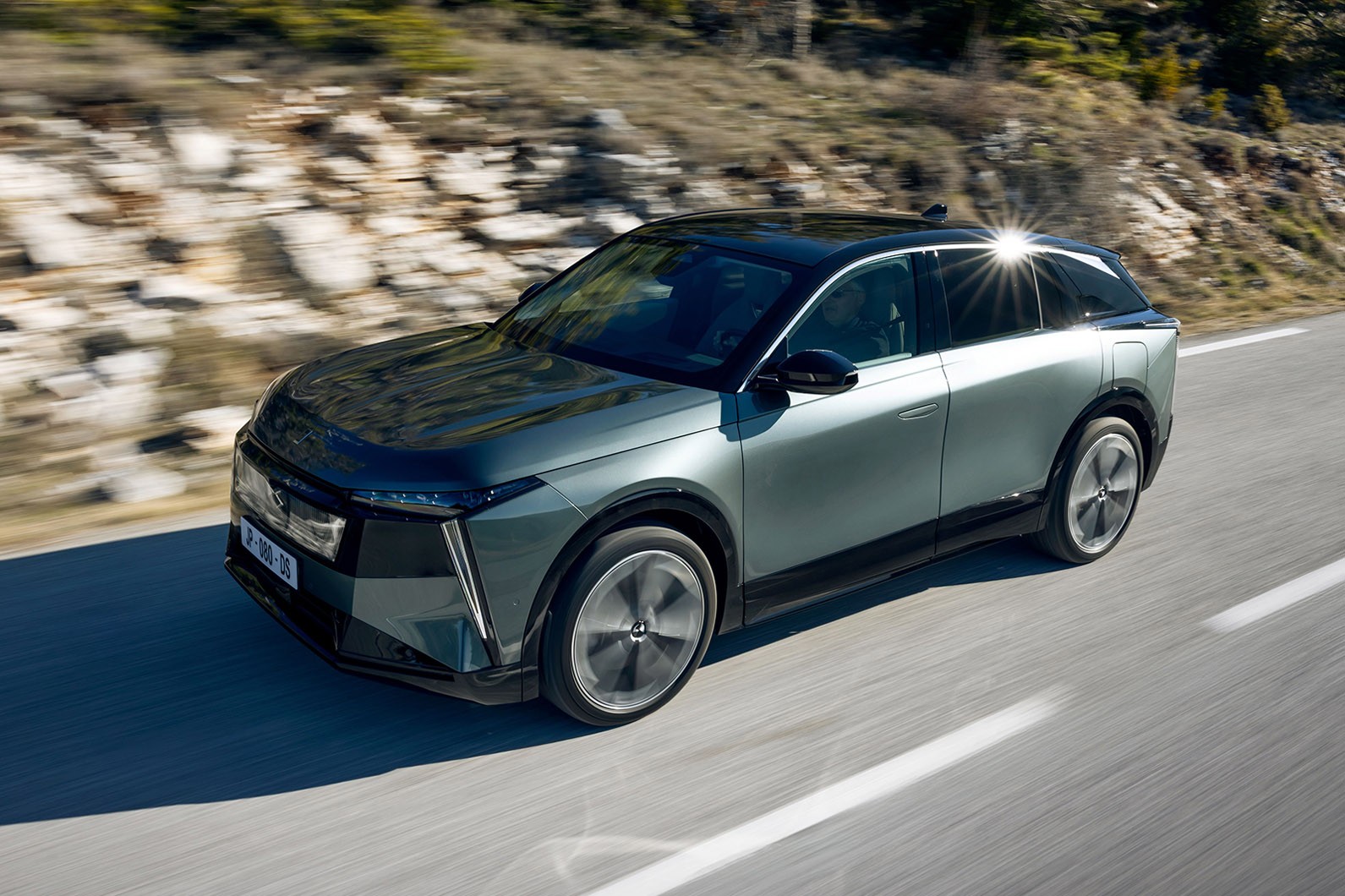
It looks like the N°8 flagship, mostly because they share DNA from the 2020 DS Aero Sport Lounge concept.
Vertical LED strips on the front nod to the 2010 Citroën DS3.
The rear lights are similar.
All of it helps cut air resistance, landing the car at a slippery 0.26 Cd coefficient.
Efficiency is clearly a religion here.
Design head Thierry Métroz joined DS on day one.
His mantra? DS cars should be the most efficient of the Stellantis family.
We will see if he keeps his promise when the new 3 comes out this autumn.
Get in.
The steering wheel looks like a steering wheel, technically speaking.
It has four spokes.
It takes a moment. Early miles might feel disjointed, maybe even awkward, but the thumb rests actually work.
Your hands sit naturally at nine and three.
It is easier to live with than you’d expect.
The materials feel plush.
There is purple Nappa leather if you are feeling bold, or navy Alcantara for something quieter.
The quirks of the original DS7 have faded. No sports car window switches anymore, no reclining rear seats designed to mock your backside.
But DS hasn’t let the switchgear become completely generic.
Lots of buttons still hide inside the central screen.
DS insists the screen faces both occupants equally. No driver-centric ego here.
Is that a good thing, or just another UI compromise?
The car is longer now. Longer body, longer wheelbase.
But does it feel bigger inside? Not really.
Space gains are modest at best.
Boot space is actually worse.
The Hybrid offers 560 liters. Drop the seats and you get 1,570.
The AWD EV loses ground again at 515 liters, expanding to 1,525.
Compare that to the old DS7’s 555 to 1,752 liters.
You lose cargo room. That is the price of entry for this new shape.
DS expects a 50/50 split between hybrid and electric sales.
Fleet buyers might sway that needle toward electric.
Our first test was the 242hp E-Tense Long Range.
0-62mph in 7.8 seconds, they say.
It feels faster than that.
The acceleration is crisp. It does not suffer the front-axle scrubbing that plagues many other front-wheel-drive EVs when you stomp the pedal.
It balances urgency with intuitive response.
Regenerative braking is adjustable.
Three modes hide behind the paddle shifters.
A proper one-pedal drive mode lives on the center console.
Curiously, if you want the auto-hold feature for the parking brake, you must be in that one-pedal setting.
Switch away and the car might roll back slightly when you lift off the brake. Even in Drive.
A strange design choice.
The Hybrid is weaker, obviously.
143bhp.
10.4 seconds to 62mph.
It works harder.
The engine clings to high revs more than you would want, sounding much more strained than it does in a tiny Corsa.
Sport mode keeps the gearbox from being too sluggish.
If you buy a “Bougie” trim level, you get a Comfort mode.
Alongside Normal, Eco, and Sport.
Comfort lets the optional road-scanning camera work.
It saw bumps coming and pre-damps the suspension.
It smooths out the rough stuff, helping an already decent ride feel luxurious.
The Hybrid rides on a simple twist-beam rear axle. The EVs get proper multi-link setups.
Ultimately, all N°7 models ride well enough for their weight.
It manages a surprising agility.
It masks the mass better than a 3008.
The E-Tense weighs over 2,200 lbs depending on spec. The Hybrid sits around 1,550kg but climbs to 1,690 with different battery packs.
Still.
It handles itself with enough grace that you forget, occasionally, just how much lead is beneath your tires.
Maybe that is the point.
To make heavy things feel light.