Crash statistics in America tell a story of drastic improvement since the mid-20th century. We aren’t talking about marginal gains. We are looking at a massive reduction in fatalities and injuries. This shift didn’t happen by accident. It was driven by a cascade of national and state-level safety laws.
The progress was slow at first. Consider the seat belt. Introduced in the 1950s, it sat in showrooms and garages for years without changing driver behavior. Adoption rates hovered around a paltry 10 to 15 percent. The data from that era was grim. In 1965, nearly six people died for every 100 million miles driven. That is a horrifyingly high number.
Things changed when enforcement tightened. Starting in 1984, laws and campaigns like “Click It or Ticket” forced a behavioral shift. Seat belt usage climbed steadily. By the early 2000s, that fatality rate had dropped to fewer than two deaths per 100 million miles driven.
Today, the pressure has shifted from legislation to technology. Drivers want better crash ratings. They demand smarter cars. Automakers are listening. The latest frontier in saving lives is the pre-collision system. These designs are meant to stop accidents before they happen, or at least soften the blow.
The Complexity of Automatic Braking
A pre-collision system (PCS) is not just a sensor. It is a complex web of algorithms and hardware. It constantly scans the road. It tracks the vehicle’s position. It watches for obstacles. If a collision seems imminent, the system intervenes.
Testing this technology is notoriously difficult. Accidents are unpredictable. The system must be finely tuned so it doesn’t trigger falsely. Nobody wants their brakes slamming on for no reason while cruising on an open highway. False positives are just as dangerous as false negatives. They erode trust. They cause rear-end collisions.
How Radar Enables Pre-Collision Systems
So how does the car know what is coming? How does it distinguish between a car merging into your lane and a shadow on the shoulder? The answer lies in radar.
Radar sensors emit radio waves. These waves bounce off objects and return to the vehicle. By measuring the time it takes for the waves to return and the change in frequency (the Doppler effect), the car calculates distance and speed. This data feeds into the PCS algorithm. If the math says you are too close, too fast, the system alerts the driver. If the driver ignores the warning, the brakes engage.
This technology is moving from optional luxury to standard equipment. It represents a fundamental change in how we view vehicle safety. We are moving from passive protection to active prevention. The question now is not if these systems will work, but how well they will adapt to the chaotic reality of the road.
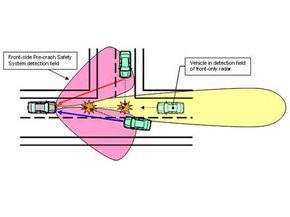
Passive safety features are the quiet guardians of the cabin. They do nothing until the moment impact arrives. A seat belt is the classic example. You click it in, and it stays loose until the physics of a crash force it to lock. Airbags sit in the dashboard, inert and useless, until sensors detect a catastrophic deceleration. But the line between passive and active safety isn’t always a clean wall. Airbags rely on impact sensors that measure the severity of a collision to decide how fast to inflate and how long to stay deployed. That real-time data processing pushes them closer to the active category.
Active safety systems don’t wait for trouble. They hunt for it. Pre-collision systems constantly scan the road ahead, analyzing the vehicle’s state in real time. They don’t just sit there. They alert the driver. They steer. They brake. They operate on a stream of signals, looking for danger before it becomes a headline.
Early attempts at collision detection tried everything. Infrared waves. Ultrasonic pulses. Most of it was unreliable. Today, the industry standard is radar. Think of it like shouting into a canyon. You hear your voice bounce back. That’s an echo. Radar does the same thing but with radio waves instead of sound. These invisible waves travel faster and farther. They cut through fog and darkness.
Inside the grille, usually tucked behind the plastic fascia, sits a small radar detector. It doesn’t stop sending out high-frequency bursts. It pulses continuously. When a wave hits a car ahead, it bounces back. The sensor catches the return. A separate control unit calculates the exact time it took for the signal to leave and come back.
This calculation happens in milliseconds.
The system instantly knows the position of the vehicle ahead. It knows the distance. It calculates speed and relative velocity. If the math suggests a crash is imminent, the system doesn’t just watch. It intervenes. It provides information to the driver or assists in avoiding the accident entirely.
But what happens when the computer decides a collision is unavoidable? How does the hardware translate data into action?
What Pre-Collision Systems Actually Do
The goal isn’t just to warn you. It’s to mitigate damage or prevent the crash altogether. When a potential collision is detected, the system escalates. It doesn’t have a single response. It has a hierarchy of interventions designed to keep you safe.
1. Warning Phase
The first step is communication. The car tells you something is wrong. Visual alerts flash on the dashboard. Audible warnings beep or chime. Some systems use haptic feedback, vibrating the steering wheel or seat to grab your attention. This gives the driver a split second to react. Often, that split second is enough. You lift off the gas. You brake. The danger passes.
2. Pre-Fill Phase
If the driver doesn’t respond, the system prepares the brakes. It pressurizes the brake lines. This is known as pre-filling. Why? Because hydraulic brakes take time to build pressure. By pre-pressurizing the system, the car eliminates the delay between you hitting the pedal and the pads gripping the rotors. When you finally brake, you get maximum stopping power instantly.
3. Automatic Emergency Braking (AEB)
If the threat remains and the driver still does nothing, the system takes over. It applies the brakes automatically. This isn’t a gentle tap. It’s a firm, controlled deceleration. The goal here varies. In some systems, the aim is to stop the car completely before impact. In others, the goal is to reduce speed significantly. Even if a crash still occurs, the lower impact speed means less structural damage and fewer injuries.
4. Post-Crash Braking
Some advanced systems continue to brake after the initial impact. If the car hits a barrier and bounces back into the path of another vehicle, the system keeps the brakes applied. This prevents secondary collisions. It’s a subtle but critical feature. You don’t notice it until you read about it in a crash report.
The Technology Behind the Sensor
Radar isn’t the only tool in the shed. Many modern vehicles use a combination of sensors. Cameras are often paired with radar. A camera sees what the radar cannot. Radar detects distance and speed with high precision. A camera
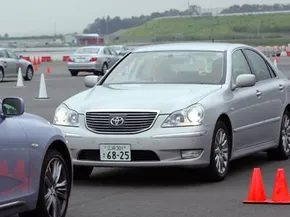
Not all safety tech just beeps at you. Some systems actually grab the wheel or squeeze the brakes. You have the passive alarms that just warn you a crash is coming, giving you a split second to react. Then there are the active interventions.
Take pre-crash braking. The system applies extra hydraulic pressure to the master cylinder. This helps the driver stop faster. It’s not a full autonomous stop, but it reduces the impact speed. That matters. Less speed means less damage.
Some of these setups talk to the seatbelt pretensioners. These are the mechanisms that tighten your restraints before impact. They pull you back into the seat. The logic is simple. A loose passenger is a projectile. A restrained one survives.
But here is the kicker. These systems need to be precise. If they trigger falsely, they distract the driver. A distracted driver causes accidents. So manufacturers test these things until they are blue in the face. False positives are unacceptable.
The Early Days: Sensing Behavior, Not Objects
Mercedes-Benz led the charge. The 2003 S-Class featured the Pre-Safe system. They called it the world’s first production car with this kind of reflex.
It didn’t look at the road ahead. It looked at how you were driving. The sensors monitored steering angle and acceleration. If you jerked the wheel or slammed the brakes, the system assumed you were avoiding a crash.
What did it do? It tightened the seat belts. It closed the sunroof. It raised reclined seats. It was all about preparing the cabin for impact, not preventing it. It was reactive, not predictive.
Radar and Millimeter Waves
Enter radar. The 2000s saw a shift toward sensing the environment, not just the car’s behavior. Toyota introduced its Pre-Collision System (PCS) in 2003 on the Harrier in Japan. By 2010, it hit the Prius.
Toyota’s system uses millimeter-wave radar. This technology can detect objects and calculate distance and relative speed. It figures out if braking help is needed. It also triggers the seat belt tensioners.
It also looks out for rear passengers. If a crash is imminent, the system reclines the rear seats to an upright position. Reclined seats are dangerous in a crash. The spine takes a beating. Upright seats distribute force across the stronger parts of the body.
The Competitive Landscape
Ford isn’t sitting back. They announced “Collision Warning with Brake Support” for the Taurus, Lincoln MKS, and MKT. It’s their take on radar-based safety.
Honda and Nissan offer lane-departure prevention and front collision avoidance on many domestic models. The technology is spreading. It’s no longer a luxury feature. It’s becoming standard.
The goal is the same across all brands. Reduce the severity of accidents. Save lives. The difference lies in the execution. Some systems prioritize braking. Others prioritize restraint. All of them rely on accurate sensors to do their jobs without annoying the driver.
Where to Go From Here
For more on the tech keeping you alive on the highway, check the links below.
Lots More Information
Related HowStuffWorks Articles
-
5 Ways Hybrid Battery Packs are Being Improved
-
How Brake Assist Works
-
How Crash Testing Works
-
Have crash tests ever used human subjects?
Sources
-
Automotive Industries. “Safety matters: advanced crash avoidance technology finds its way into production vehicles in Japan.” Aug. 2004. (April 13, 2009) http://findarticles.com/p/articles/mi_m3012/is_8_184/ai_n6173980/
-
DENSO Corporation. “Pre-crash Safety System.” Oct. 22, 2003. (April 6, 2009) http://www.globaldenso.com/en/technology/product/electronics/files/pdf12_e.pdf
-
Ford.com. “Ford’s latest safety breakthrough – Collision Warning with Brake Support – Coming in 2009.” April 6, 2009. (April 6, 2009) http://media.ford.com/article_display.cfm?article_id=29188
-
Lemmen, Paul et al. “Development of a Pre-Crash System Using the VEHIL Test Facility.” National Highway Traffic Safety Administration. March 8, 2005. (April 6, 2009) http://www-nrd.nhtsa.dot.gov/pdf/esv/esv19/05-0322-O.pdf
-
Mercedes-Benz Canada. “Mercedes-Benz launches first-ever car with ‘reflexes.'” Oct. 15, 2002. (April 6, 2009) http://www.mercedes-benz.ca/index.cfm?NewsID=121&id=2959
-
Merkelbach, Bettina. “Toyota Adds Front-Side Pre-Crash System and Seatbacks to Safety Technologies.” ATZ online. March 2, 2009. (April 6, 2009) http://www.atzonline.com/index.php%3Bdo=show/site=a4e/sid=65255547349e36722b41f2291479446/alloc=1/id=9270