Most cruisers in the late 90s followed a strict formula. You got a 45-degree V-twin. You got a shaft drive. You got the usual chrome. Yamaha ignored the script.
The 1997 Yamaha Royal Star Palamino Edition didn’t just look different. It ran on something entirely different. While Honda and Suzuki were busy building V-twins, Yamaha went back to the drawing board for the Royal Star lineage. They didn’t want to copy the American aesthetic. They wanted to engineer a better one.
The Engine Architecture
This is where the Royal Star gets interesting. Forget the V-twin.
The Royal Star uses a 1300-cc V-four configuration. That’s right. Four cylinders.
The cylinder banks are spread apart by 70 degrees. Each bank has double-overhead cams (DOHC). It’s a complex setup for a cruiser. Most bikes in this class keep things simple. Yamaha kept it advanced.
Cooling is primarily water-based. There are fins on the cylinders, but they’re not for airflow. They’re mostly decorative. The shaft drive remains traditional. But the engine? It’s a standout.
Styling and Comfort Details
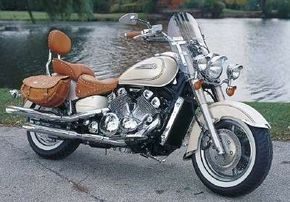
The Palamino Edition takes the standard Royal Star and dials up the luxury. It’s subtle. It’s detailed. It’s aimed at riders who want a bike that looks like it costs more than it does.
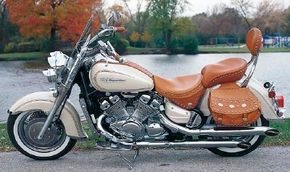
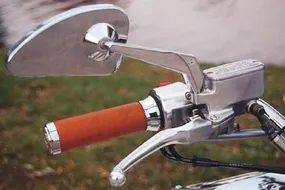
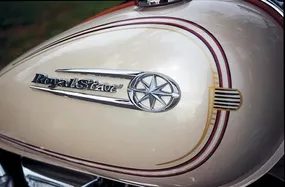
Cream opalescent paint. That’s the base. Tan imitation leather covers the seat, saddlebags, and tank strap. Every piece is studded. Even the hand grips match. Chrome trim is everywhere. It’s not flashy. It’s refined.
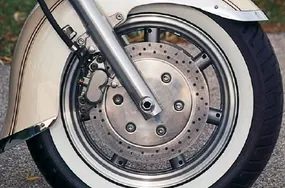
The wheels are cast spokes. They’re hidden behind large brake discs. You don’t see the spokes. You see the brakes. You see the paint.
Historical Context
Yamaha didn’t invent the cruiser. But they were the first Japanese company to sell one successfully. That started with the Virago in the early 1980s.
The Royal Star changed the game. It moved the concept into the 21st Century. It proved a Japanese manufacturer could build a heavyweight cruiser with American proportions and Japanese reliability.
The Palamino Edition was the peak of that era. Fine details. Unique engine. No compromise.
Why It Matters Now
You can still find Royal Stars on the used market. They’re not rare. They’re not cheap. But they’re not expensive either. They’re a sweet spot.
The V4 engine gives it a unique sound. It’s smoother than a V-twin. It’s faster. It’s less common. That makes it interesting.
For collectors, the Palamino Edition is a specific variant. The cream paint. The tan leather. The studs. It’s distinct. It’s recognizable. It’s not just another Royal Star.
Is it the best cruiser of the 90s? Maybe. Is it the most popular? No. But it’s the most interesting.
The 1997 model year was the last for the original Royal Star platform. Yamaha updated it later. The engine changed. The styling changed. The Palamino Edition remains a standalone piece of history.
It’s
The Anomaly of the 1997 Yamaha Royal Star
It sits there, looking every bit the part of a classic American cruiser. Low seat height. Wide stance. Chrome that catches the sun. The 1997 Yamaha Royal Star Palamino Edition has the aesthetic down pat, but pop the hood—or rather, the tank—and you are looking at something that breaks the rules.
Most cruisers rely on V-twin engines. It is the industry standard. The rhythmic thump of two cylinders firing out of phase is what defines the genre. Yamaha ignored that convention. Instead of a V-twin, they stuffed a 1300-cc V-four engine into the frame.
Why does this matter? Because a four-cylinder cruiser behaves differently than its two-cylinder counterparts. The power delivery is smoother. Higher revving. More linear. It does not lurch; it flows.
Smoother Power Delivery
The choice of a V-four was not arbitrary. Yamaha wanted to offer a cruiser that felt more like a sport-touring bike in terms of refinement. The inline-four vibe, even in a V-configuration, provides a flatter torque curve. You get power earlier and more consistently.
For riders who find traditional V-twins too choppy or too low in the powerband, this engine configuration offers a compelling alternative. It is not just about looks. It is about how the machine moves.
The Palamino Edition Specifics
The 1997 Palamino Edition was not just a color swap. It came with specific touches that set it apart from the base model. Cream and blue graphics. Distinctive badging. These details mattered to buyers looking for something unique in a sea of black-and-chrome.
But the real distinction remains under the seat. That massive V-four.
Why It Stands Out
The market was flooded with V-twins in the late 90s. Yamaha’s Royal Star was a statement. It said you could have cruiser comfort without sacrificing mid-range punch. It appealed to riders who wanted the style but demanded more performance.
Today, it remains a niche vehicle. A curiosity. A bike that defies categorization by simply not playing by the usual rules.
If you know your motorcycles, you know that a 1300-cc V-four in a cruiser chassis is rare. It is not just a different engine. It is a different driving experience.
Finding One Now
Searching for a well-kept example requires patience. These were not mass-market sellers like the Honda Goldwing or the Harley-Davidson Softail. They were a specific choice for a specific rider.
Condition varies. Maintenance history is critical. The V-four is robust, but it is complex compared to a simple V-twin. Parts can be harder to source than for mainstream cruisers.
Still, the Royal Star holds a unique place in Yamaha’s history. It proved that a four-cylinder could live comfortably in the cruiser world. It did not just survive. It thrived by being different.
There is something satisfying about riding a machine that refuses to fit into a box. The Royal Star Palamino Edition still does that.