The popular history books like to paint the 1967-1969 Chevrolet Camaro as a panicked, reactionary move—a classic “me-too” product designed solely to chase Ford’s Mustang. That narrative is lazy. It ignores the fact that Chevrolet’s own Corvair Monza had already mapped out the lucrative market for sporty compacts before Henry Ford ever unveiled his pony car. General Motors was actually thinking about building a Mustang-style rival more than two years before the Ford Mustang launched in mid-1964. The delay wasn’t lack of vision. It was indecision.
The Corvair Detour
GM executives had high hopes that the restyled second-generation Corvair Monza would halt the stampede to Ford’s new “pony” segment. The cars looked good. They were sleek. But they suffered from a fatal architectural flaw that the public found too weird to embrace. The Corvair used an air-cooled, rear-engine layout. Meanwhile, the Mustang was built on the orthodox, reliable, and affordable Falcon platform, priced at a tempting $2,500.
The Corvair’s technical uniqueness made it a manufacturing headache. It was costly to build and difficult to market. Even as the redesigned 1965 models hit the showrooms, GM managers were quietly deciding to let the Corvair fade into obscurity rather than fight a war they were losing on two fronts: engineering and public perception.
The Real Mustang Fighter
With the Corvair shelved, Chevy rushed to finish a conventional front-engine replacement. They called it the Camaro. The blueprint was familiar because it was borrowed directly from Ford’s playbook. The wheelbase matched the Mustang. The under-skin components were liberally stripped from the Chevy II, a “family” compact within the GM stable. The styling hit all the right notes: long hood, short deck, rakish lines. It came standard with front bucket seats and eventually offered 81 factory options plus 41 dealer-installed accessories.
The engineering philosophy was sound on paper. Chevy opted for unit construction paired with a front subframe. This setup cradled the engine and transmission on large rubber mounts, a smart move to minimize noise, vibration, and harshness. The front suspension used wishbones and coil springs. The springs sat between the arms rather than atop the upper ones. This subtle shift improved handling dynamics significantly.
Flaws in the Foundation
The rear suspension told a different story. It relied on cheap “Mono-Plate” single-leaf springs. This design was catastrophic for performance. Under hard acceleration with the planned V-8 engines, the rear axle experienced severe tramp. The wheels would hop and lose traction. This flaw wasn’t caught until the eleventh hour of production.
To combat the issue, 1967 V-8 Camaros were forced to add rear traction bars. Later models added staggered shocks. Neither solution was a genuine cure. They were band-aids on a broken leg. The rear end would still bottom out easily. The chassis was compromised from the start.
Why the 1967-1969 Camaro Matters
The Camaro wasn’t just a copycat. It was a refined evolution of a concept GM had been brewing for years. The styling succeeded where the Corvair failed. The sales figures proved the market was hungry for this specific combination of style and performance. But the engineering compromises lingered. The rear suspension issues would plague the model for years.
The 1967-1969 Camaro stands as a testament to GM’s ability to pivot. They had the idea first. They had the platform ready. They just hesitated. By the time they committed, Ford had already set the standard. The Camaro had to be better. It was fast. It was beautiful. It was flawed. Just like the best muscle cars.
The 1967 Camaro’s Design Paradox
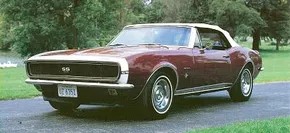
Bill Mitchell, GM’s design chief, watched the 1967-1969 Chevrolet Camaro take shape with a critical eye. He reportedly disliked the final result. This is ironic, given that the styling is now considered nearly perfect. It was chiseled yet flowing. It looked decisively different from the Ford Mustang.
Yet, the Camaro mimicked its rival. It aimed to be all things to all sporty-car buyers.
Engine Lineup and The Big-Block Loophole
The base model started as a hardtop coupe or convertible with a 230-cid six-cylinder engine. You could step up to a 250-cid six for just $26. V-8 buyers had choices: a 327 or a 350.
The 350 V-8 was tied to the $211 Super Sport package. This kit added stiff suspension. It included D70 x14 tires. The hood was modified with extra sound insulation. “Bumblebee” nose stripes finished the look.
Midseason, dealers offered a pair of 396 big-blocks. These made 325 and 350 bhp. Why the dealer-only route? It bypassed a GM ceiling on “excessive” small-car displacement.
Interior and The Rally Sport Package
Other tempting 1967 options included a Custom interior. The Strato-Back front bench seat was rarely ordered. A fold-down rear seat was available. Extra gauges and console shifters were common additions.
Shifter options matched the transmissions: a two-speed Powerglide automatic, a Heavy-Duty three-speed manual, or a four-speed manual.
The $105 Rally Sport package added a hidden-headlight grille. This was a defining touch for many buyers. Additional extras ran to tinted glass. Heater and air conditioning were available. Cruise control and a vinyl roof for hardtops rounded out the list.
Performance Hardware
Functional items mattered here. Sintered-metallic brake linings were standard. Vented power front-disc brakes were an option. Quick-ratio manual steering improved feel. Positraction limited-slip differential was key for traction. A dozen different axle ratios were available.
With all this, delivered prices could easily exceed $5,000.
Sales Success
Camaro may have trod Mustang’s trail, but it succeeded on its own. Mustang outsold it in 1967. Still, Camaro’s 220,000 orders represented fully 10 percent of Chevy’s total volume that year.
Among them were 100 “Official Pace Car” convertibles from the Indianapolis “500.” These were not publicly sold. Also included were 602 of the now-legendary Z-28s.
Sales numbers tell a simple story for the late-60s Camaro. 1968 brought a bump of roughly 15,000 units despite minimal updates and fresh competition hitting the showrooms. You could spot a ’68 instantly. Washington’s new mandate for side-marker lights made them easy to identify, alongside a revised grille and one-piece door glass. That glass signaled Chevrolet’s new flow-through “Astro Ventilation” system. Options stayed mostly the same, with one notable exception: a third 396 engine option, rated at 375 bhp.
The 1969 model year saw more extensive revisions. This was smart timing. The ’69s would sell into early 1970, buying time for the delayed, all-new second-generation Camaro. A deft lower-body reskin introduced a vee’d eggcrate grille. “Speed streaks” ran above the wheel arches. The tail was reshaped too. RS headlamps remained hidden when off. Glass slots allowed some light to shine through if the covers failed to retract. Instruments were revamped. Some engine choices changed as well. Sales eased, but not greatly.
Camaro paced the Indy “500” again in ’69. Chevrolet cashed in by selling 3,475 “Pacesetter Value Package” convertibles. They went for about $3,500 apiece. Of these, only four (perhaps more) were equipped like the three “real” pacers.
Keep reading to learn about the specifications of the 1967-1969 Chevrolet Camaro.
For more information on cars, check out:
-
Classic Cars
-
Muscle Cars
-
Sports Cars
-
Consumer Guide New Car Search
-
Consumer Guide Used Car Search
1967, 11968, 1969 Chevrolet Camaro Specifications
The Spec Sheet Behind the Pony Car War
The 1967-1969 Chevrolet Camaro wasn’t just trying to out-punch the Ford Mustang in sales. It was trying to reinvent the formula. While the Mustang leaned into retro-modern elegance, the Camaro went for a sharper, more aggressive geometry. You can see that divergence in the metal. But before you judge the styling, you have to look under the hood. The hardware told a different story than the sheetmetal.
Engine Options and Output
Chevy gave buyers a ladder of power. It started with the base inline-six, which felt dated against the V-8 options sitting next to it. The 1967 and 1968 models carried the 230 cid (3.88 x 3.25) OHV I-6, pushing 140 bhp. It wasn’t exciting. It was transportation.
For 1969, they bumped the six to 250 cid (3.88 x 3.53), raising output to 155 bhp. Still not a muscle car. That’s why the V-8s mattered. The entry-level V-8 in 1969 was the 307 cid (3.88 x 3.25), making 200 bhp. A step up, but barely.
The real contention started with the 327 cid (4.00 x 3.25). Depending on the carburetor and compression, it made 210 or 275 bhp. This was the sweet spot for many buyers. Want more? The 350 cid (4.00 x 3.48) offered 255 or 295 bhp. It became the new standard for performance. For the absolute top tier, the 396 cid (4.09 x 3.76) ruled with 325, 350, or 375 bhp options. That was serious torque.
Drivetrain and Chassis Dynamics
Power had to go somewhere. The transmission choices were limited. You could choose a 3-speed or 4-speed manual for driver engagement. Or you could opt for the 2-speed Powerglide automatic. It was simple. Reliable. Not exactly sporty.
The suspension setup was traditional. Up front, upper and lower A-arms paired with coil springs provided the geometry. It wasn’t independent. It was solid. In the rear, a live axle sat on semi-elliptic leaf springs. This setup handled weight transfer well but could be twitchy if you got it loose in a corner.
Brakes and Dimensions
Stopping power relied on front and rear drums. If you wanted to stop faster, you had to pay extra for optional front discs. Standard brakes were adequate for street use, but not for track days.
The wheelbase was a tight 108.0 inches. That short wheelbase made the car feel nimble. It also made it feel small. Weight ranged from 2770 to 3295 lbs, depending on the engine and options. He