Car companies sell hybrids as the bleeding edge of automotive innovation. They pitch them as the futuristic solution to getting from point A to point B. It’s a lie, mostly. The basic architecture of the modern hybrid is over a century old.
We are talking about the turn of the 20th century. America, London, Germany. The systems used today mirror those early experiments almost exactly.
How did the first hybrid cars work in the early 1900s?
A hybrid uses two power sources. Today, that usually means a gas-electric hybrid. You get an internal combustion engine (ICE) and an electric motor fed by a battery pack. Simple.
But rewind to the late 1800s. Electric vehicles were the cool kids. Not hybrids. Pure EVs.
In 1897, the London Electric Cab Company was running cabs on 40-cell batteries. They had 3-horsepower motors. Range? 50 miles (80 kilometers). No stops to refuel. Just electricity.
Two years later, Pope Manufacturing in Hartford, Connecticut, churned out nearly 500 electric cars. They were selling. They were popular.
While Pope was building batteries, Ferdinand Porsche was building something else.
Porsche worked for the Lohner Carriage Company. They wanted to enter the horseless carriage market. Porsche’s first car for them? The Lohner Electric Chaise. It was the world’s first front-wheel-drive vehicle. Electric.
His second car changed everything. It was the first-ever hybrid.
Why was the Lohner-Porsche the first series hybrid?
Porsche didn’t just mix gas and electric. He built a series hybrid.
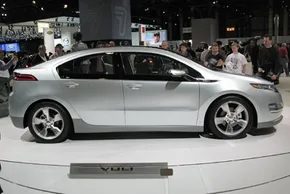
This is the same architecture you see in cars like the Chevy Volt. The key difference? The batteries do the driving. The internal combustion engine never touches the wheels.
Here is how it worked:
- The gas engine ran at a constant, optimal speed.
- It spun a generator.
- The generator charged the batteries.
- The batteries sent electricity to motors located directly in the wheel hubs.
When fully charged, the Lohner-Porsche could travel nearly 40 miles (64.3 kilometers).
It was ahead of its time. Not just because it was a hybrid, but because of the hub motors.
Porsche put motors in the wheels. This eliminated the gearbox. No drive shafts. No chains. No clutch.
Why does that matter?
Friction. Mechanical friction eats energy. By removing all that metal-on-metal grinding, Porsche’s car used 83 percent of the energy it produced. That efficiency rate is insane for 1900.
A few years later, he added hub motors to all four wheels. Four-wheel drive. Electric. The car hit 70 mph (112.6 km/h).
Which early hybrid design became the standard today?
Porsche’s series hybrid was brilliant. But it wasn’t the only game in town.
Enter Henri Pieper. A German inventor who applied for a U.S. patent in 1905. He got it in 1909.
Pieper’s design looked a lot more like what drives on our highways today.
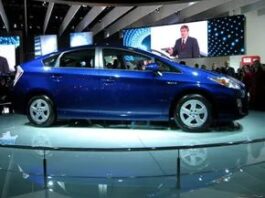
Think of the Toyota Prius or the Honda Insight. Those are parallel hybrids.
In a parallel system, both the gas engine and the electric motor can power the wheels directly. They work together.
- Cruising? The electric motor might handle it alone.
- Need a hill climb? Both kick in.
- Braking or coasting? The electric motor acts as a generator, recharging the batteries.
Pieper figured this out before most people had telephones in their homes.
So, we had Porsche’s series hybrid. We had Pieper’s parallel hybrid. We had pure electrics from Pope and London cabs.
The technology was there. The engineering was solid.
So why didn’t it stick? Why did the gas-only car win for the next century?
The answer isn’t about the tech. It’s about the market. And the infrastructure.

The long road to the modern hybrid
Turns out we got it wrong. A long time ago.
At the 1900 National Automobile Show in New York City, attendees voted on their preferred vehicle type. The winner? Electric vehicles. Steam-powered cars came in second. Internal combustion engines? Last place.
It makes sense when you think about it. Early ICE cars were noisy, smelly, and jerky. Electric cars were quiet. Clean. Easy to start with a switch. Steam was powerful but slow to heat up. Then came Henry Ford.
He didn’t care about polls. He cared about volume.
Ford’s assembly line churned out lightweight, inexpensive cars that the general public could actually afford. The Model T was the killer app. In 1913 alone, Ford sold 182,809 of them. Meanwhile, sales of cars that didn’t run exclusively on gasoline began dropping steadily. The convenience and cost of the gasoline-powered mass market crushed the early alternatives. Hybrid vehicle production, which had seen thousands of units rolling off the line, slowed to a crawl.
Why hybrids vanished for fifty years
It wasn’t until the late 1960s and early 1970s that automakers and scientists looked back at the drawing board. Specifically, at alternative powertrains.
The catalyst was the oil embargo in the early 1970s. Gas prices spiked. Supply dried up. The Department of Energy started testing various car technologies to reduce reliance on imported oil. One standout was the VW Taxi, created by Volkswagen.
It was a parallel hybrid car. That means it could switch between an internal combustion engine powered by gasoline and electric power. It wasn’t the Prius, but it was the ghost of the future returning.
From niche experiments to mass market reality
For the next few decades, car companies tinkered. They experimented. But nothing stuck in the mainstream until the late 90s.
In 1999, Honda sold the first mass-market hybrid in the United States: the Insight. It was small. Efficient. It proved the concept could work on a scale bigger than a taxi fleet.
One year later, Toyota introduced the Prius. This was the big one. The Prius won the Motor Trend Car of the Year award in 2004. It defined the modern hybrid.
Here is the technical nuance that matters. Both the Insight and the Prius use a parallel hybrid system. But Porsche’s series parallel system is still used in hybrids today. The technology didn’t just improve; it diversified.
What changed in a century?
It took almost one hundred years for automakers to mass-produce hybrid vehicles in America again. That gap wasn’t empty. It was filled with progress.
Battery technology improved. Engine efficiency went up. Electrical systems got smarter. These advancements allowed for greater opportunity for future hybrid vehicles. The early 1900s hybrids were curiosities. Today’s hybrids are engineering refinements of a concept that was popular before the gasoline era took over.
The loop is closed. Electric and hybrid power isn’t new. It’s just finally competitive again.