Downtown Los Angeles is a beast. On a Friday afternoon, the streets choke with people trying to escape, which only makes the gridlock worse. It feels like a stampede for Black Friday sales, just with more exhaust and less shopping.
You rely on the subway. It’s reliable. You walk to the station, dodging cabs and weaving through traffic like a pro. You’ve got the rhythm down. You reach the corner. One last street to cross. You step out.
A horn blasts.
A Honda Civic screams to a halt ten feet past your toes. You jump back. Your heart hammers. You didn’t see it coming. You didn’t hear it. You thought the car parked there was empty. It wasn’t.
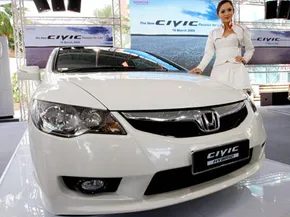
The Honda Civic Hybrid.
The engine only runs when it needs to. That’s the catch. You walked into its blind spot because the car was silent. This is the danger of quiet efficiency. Hybrid vehicles don’t look different. They sit in traffic like any other sedan. But the electrical components change the game.
Honda’s secret lies in how it manages power. You need to understand the Integrated Motor Assist (IMA) system to see why that Civic was so hard to spot. It’s not just an engine. It’s a dance between gas and electricity. And in the chaos of LA traffic, that silence is lethal.
The Mechanics of the Hybrid Advantage
The Civic Hybrid uses a specific setup. It pairs a standard internal combustion engine with an electric motor. The electric motor helps the gas engine. It doesn’t replace it entirely. This is the Integrated Motor Assist system.
Honda developed this to boost fuel economy without losing performance. The electric motor provides torque at low speeds. This is where efficiency matters most. Stop-and-go traffic kills gas mileage. The hybrid system mitigates this.
When you accelerate gently, the electric motor takes the lead. The gas engine stays off. The car is silent. This is why you didn’t hear it. The driver didn’t either. The system kicks in automatically. You feel the push. You don’t hear the roar.
The gas engine engages when you need more power. Or when the battery needs charging. It’s not a plug-in. You can’t charge it externally. The regenerative braking system charges the battery while you drive. Braking captures energy. That energy powers the electric motor later.
This cycle repeats constantly. The system decides which power source to use. It’s smart. It’s efficient. But it’s also quiet. In a city full of noise, silence blends in. The Civic becomes a ghost car.
Why Silence is a Safety Issue
Pedestrians rely on sound. Cars announce their approach. An engine growl. Tires humming. A horn. Hybrids disrupt this. They are stealthy. This isn’t a flaw. It’s a feature. But it creates danger.
You walked into the street because the car was silent. You assumed it was parked. You were wrong. The driver saw you too late. The brakes squealed. The car stopped inches from your leg.
This is the reality of hybrid adoption. More silent cars on the road. Fewer auditory cues for pedestrians. The National Highway Traffic Safety Administration has studied this. They warn about increased crossing accidents. Pedestrians don’t hear approaching hybrids.
Honda knows this. They didn’t design the IMA system to be dangerous. They designed it to be efficient. The silence is a side effect of the technology. But the side effect has consequences.
You need to
The Civic Hybrid’s Mechanical Heart
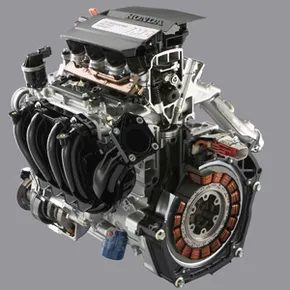
If you pulled the engines out of a standard Civic and a Civic Hybrid and laid them side-by-side, the similarities would vanish past the flywheel. The hybrid swaps that traditional flywheel for an electric motor bolted directly to the crankshaft. This isn’t just an add-on. It’s the core of the IMA (Integrated Motor Assist) system.
Built with high-density coil windings and powerful magnets, this motor acts as the starter, the propulsion assist, and the generator. It’s a compact piece of engineering that handles the heavy lifting when the gas engine needs a break.
The magic happens in how the electric motor and the internal combustion engine talk to each other. Honda’s IMA system doesn’t just add power. It substitutes electric torque for gas power under specific conditions. We’ll get to the exact scenarios soon, but for now, know that the energy source is a nickel-metal hydride (NiMH) battery pack. This battery doesn’t need plugging in. It charges itself through regenerative braking. When you lift off the gas or hit the brakes, the electric motor flips roles. It becomes a generator, capturing kinetic energy that would otherwise vanish as heat, and storing it for later use.
Under the Hood: Specs and Engineering
You might wonder what actually defines a hybrid. How is it different from your average commuter car? The short answer: not much in terms of driving feel, but everything under the skin. A hybrid like the Civic, or a Toyota Prius, blends internal combustion with electric power. They work in tandem. The driver rarely sees the switch happen.
Let’s look at the 2009 model. It features Honda’s fourth-generation gas-electric power plant. Like the rest of the Honda lineup, it uses an inline 4-cylinder engine. But this one is equipped with a refined version of their famous VTEC system, called i-VTEC (intelligent-VTEC).
Most cars have two-stage valve timing. This one has three. Low RPM, high RPM, and idle. Each stage uses a different set of rocker arm assemblies controlled by the engine’s computer. The ECU monitors variables in real-time, adjusting camshaft profiles to squeeze out maximum efficiency without sacrificing power.
There’s another trick up the sleeve. When the car is idling or decelerating, the computer shuts down and seals the combustion chambers in each cylinder. This reduces pumping losses. It adds about 10 percent fuel efficiency over the first-generation Civic Hybrid engine.
Honda also obsessed over friction. The pistons are die-cast aluminum. They don’t expand much under heat. Less expansion means less friction against the cylinder walls, even in extreme temperatures. The walls are plateau-honed for a better seal. The piston rings are ion-plated. The result is silky-smooth operation.
Power gets to the front wheels through a continuously variable transmission (CVT). The 1.3-liter engine pushes out 110 horsepower and 123 pound-feet (167 newton-meters) of torque.
The numbers tell the real story. The Civic Hybrid hits 40 mpg in the city. 45 mpg on the highway. Compare that to the standard Civic’s 26 city and 34 highway. That’s a significant gap. The efficiency gains aren’t just theoretical. They’re measurable in every gallon.
The Benchmark: Honda Insight
Efficiency isn’t new to Honda. It’s in their DNA. Consider the original Honda Insight. Back in 1999, Honda challenged automotive journalists to a fuel economy test. The route was 195 miles from Columbus, Ohio, to Detroit, Michigan.
Car & Driver took the wheel. They drafted behind a massive Ford Excursion to minimize wind resistance. Averaging 58 mph, they returned a staggering 121.7 mpg. It was an anomaly. A demonstration of what happens when you strip away weight and aerodynamic drag.
But the Civic Hybrid isn’t trying to be the Insight. It’s trying to be practical. It’s trying to prove that you don’t need a three-wheeled pod to save fuel. You just need smart engineering.
So, what does it feel like? Numbers on a page don’t capture the drive. The transition between electric and gas power is the real test. Is it jarring? Is it smooth? Does the car feel alive, or does it feel like a appliance?
That’s the next question. And it’s the one that matters most when you’re sitting behind the wheel.
How the Honda Civic Hybrid IMA System Actually Works
Think about the last time you drove a standard gas-powered golf cart. You know the drill. You sit there, engine silent, until you mashing the accelerator. Then—bam—the engine roars to life. It isn’t running continuously while you putt across the green. It only engages when you demand power.
This is a low-tech, surprisingly accurate analogy for what happens under the hood of a hybrid like the Honda Civic Hybrid.
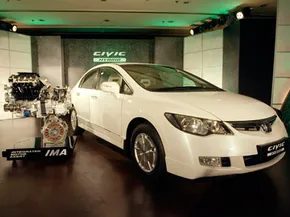
It’s not exactly the same, of course. The Civic is far more complex. It involves an electric motor, sensors, and software. But the basic philosophy of “only run when needed” is identical. The secret sauce here is the Integrated Motor Assist (IMA) system. This is what bridges the gap between a standard internal combustion engine and a full electric vehicle.
Here is exactly how the i-VTEC engine and the electric motor share the workload, depending on what you’re doing with the car.
Stationary and Initial Launch
When you are stopped at a light or in traffic, the gasoline engine is off. Zero fuel is being burned. It’s just sitting there.
When you press the gas pedal to move, the electric motor takes the lead. It pulls the Civic Hybrid away from the stop line. As the car gathers speed, the gasoline engine wakes up. But it doesn’t just rev wildly. It kicks into a low-rpm valve timing stage designed for efficiency. The motor helps push, the engine assists, and you’re moving with minimal effort.
The Power Move
Need to pass a truck? Slam the pedal.
The system shifts gears. The engine moves to its high-rpm valve timing stage for maximum power. The electric motor doesn’t quit; it adds torque to help the engine out of the hole. This is where the hybrid advantage shines. You get the punch of a larger engine without the constant fuel penalty of running it at high output all the time.
Low-Speed Cruising
Here’s where it gets interesting. If you’re crawling through a parking lot or driving in stop-and-go traffic at low speeds, the gasoline engine can actually shut off completely.
The combustion chambers are sealed. The pistons are still. The car is being towed by the electric motor alone. It’s silent. It’s clean. And it makes the hybrid feel less like a car and more like a sophisticated appliance.
Regenerative Braking
You don’t have to do anything special. There’s no button to press for “regen mode.” Just lift off the accelerator or tap the brake.
As the car decelerates, the engine cuts out again. The electric motor flips its polarity. Instead of drawing power from the battery to move the wheels, it uses the momentum of the car to generate electricity. This energy gets stored back in the battery pack. You are essentially recycling your own kinetic energy.
The Driver Experience
The beauty of the IMA system is that it’s invisible. You don’t feel the switches. You don’t hear the engine stuttering on and off in a way that breaks immersion. The software manages the handoffs between electric and gas power so smoothly that you just drive.
It feels normal. It drives normal. But you’re saving fuel.
If you want to dig deeper into how this technology compares to other hybrids on the market, or how it stacks up against the Ford Fusion Hybrid or the Toyota Prius, there are plenty of road tests and technical breakdowns available online. The core concept remains the same: use electricity for the grunt work, use gas for the heavy lifting, and let the computer handle the rest.