Speed is often a temporary concept. It could be the blur outside the window, the numbers on the dashboard, or the reason you stopped. But for those who are hooked, this speed is not temporary. It’s a hard number etched into history. These are more than just fast cars and boats. They are a technical anomaly. The machines are built with one purpose in mind. going faster than physics wants them to.
This is where the rubber meets the road, the propeller meets the water and the wheels meet the rails.
Land speed record
October 15, 1997, Black Rock Desert, Nevada. Air dry. The ground is hard. Andy Green is a former Royal Air Force fighter pilot with a ThrustSSC.
This wasn’t a modified street car. It is a jet powered vehicle with two afterburning Rolls-Royce Spey engines. The same engines that powered the Phantom jets Green flew. The fuel burns at a rate of 4.8 gallons per second. What is the fuel consumption? 0.04 miles per gallon.
Green reached 763.035 mph.
“Green became the first driver to break the sound barrier, reaching 761 miles per hour in the process.”
Earlier that year, he set a record of 714.144 mph. This is the last pass. The sound barrier wasn’t just broken. It shattered. ThrustSSC holds the land speed record to this day. In official conditions, no other wheeled vehicle comes close to this number.
The secret of underwater speed
There are no official underwater speed records. Why? Secrecy. Governments do not publish the maximum speed of nuclear submarines. This is a defense issue.
But there are unofficial figures. The USS Albacore is a Gato-class submarine built in 1965 and capable of 33 knots (38 mph). This is a benchmark.
Russia claims even more. The underwater speed of the Akula class submarine is said to be 35 knots. The older Alfa-class, replaced by the Akula, which could run up to 44.7 knots (51.4 mph) for a short time. This speed is dangerous. At such speeds, cavitation and hydrodynamic stresses tear the hull apart. These are estimates based on leaks and technical limitations, not public logs.
The fastest bike
Chris Carr didn’t just ride fast. He made history.
September 5, 2006. Bonneville Salt Flats, Utah. The salt is so flat you can see the bends. Carr was on the Number Seven Streamliner. This is no ordinary Harley. It’s powered by a turbocharged V4 engine designed for speed, not torque.
He made two passes. Average speed? 350.8 mph. His fastest single pass? 354 miles per hour.
The Number Seven Streamliner was an aerodynamic coffin. Low drag coefficient. Minimal surface area. Carr survived. He is the only person to have officially broken the 350 mph mark on a motorcycle. Other competitors have also tried it. Few people maintain an upright posture. If this had not been done, even fewer people would have survived.
Speedboat in the backyard
Ken Warby does not work for a yacht builder. He works in his backyard in Australia.
The Spirit of Australia was created by Warby himself. material? Balsa wood. fiberglass. And a surplus military jet engine he bought for $69.
October 8, 1978. Blowering Dam. Warby drove his creation to an average speed of 318.75 mph. He broke his own record of 290.313 mph set last year.
This is the fastest speedboat ever recorded. No one else has gone faster and lived to tell this tale. Australian Spirit is a testament to amateur technique and violence. At over 300 miles per hour, the force of the water can lift a ship out of the water and break it in two. Warby glued it to the surface.
Sailing speed record
No need for a motor. You need wind.
Irishman Finian Maynard is proof of this. April 2005. Sainte-Marie-sur-Mer, France. The competition route is 500 meters. Maynard was on a sailboard. Yes, it’s a surfboard with a sail.
His speed was 48.7 knots. That’s about 56 miles per hour. He broke his own record of 46.82 knots set in November 2004.
The sailboard is the smallest and fastest sailing vessel. It depends on the rider’s balance and the strong wind. There is no frame. There is no keel. All you need is a board, a sail and some raw speed.
Long distance sailing ship
It’s not about short bursts. Durability is important.
Orange II is a 125 foot catamaran that holds the long distance record. In July 2006, a crew led by French sailor Bruno Peyron crossed the Atlantic Ocean.
Average speed? 28 knots (32 mph). Total time? 4 days, 8 hours, 23 minutes and 54 seconds.
They also hold records for traveling around the world. March 16, 2005, 27,000 nautical miles. 50 days, 16 hours and 20 minutes. The average speed is 17.89 knots. Orange II demonstrates that wind power, optimized using carbon fiber and hydrofoils, can outpace many motorized vessels over long distances.
Fast train and rocket sled
Wheels on rails? France’s TGV holds the record for traditional trains. Test drive on April 3, 2007. Two engine cars, three double-decker passenger cars. speed? 357.2 mph.
Magnetic levitation? Japan’s JR Maglev captured its crown on December 2, 2003. It floated above the track using superconducting magnets. speed? 361 miles per hour.
But what happens when you remove the human element and add rockets? The numbers are starting to look crazy.
April 30, 2003 Holloman Air Force Base, New Mexico. Unmanned 4-stage rocket sled. There are no passengers. There are no brakes. Just thrust. It reached 6,416 miles per hour.
That’s Mach 8.4. Rocket sled is the fastest man-made object that moves on rails. It’s not a means of transportation. This is a testing tool. But the speed is real.
Human-powered bicycle
Pedal faster than the car? Yes, except for the wind.
Fred Rompelberg set the regular upright bike record in 1995 at 166.944 mph. But he is not alone. He was paced by a motor vehicle. The bike, the VelOSpeed, was tucked behind a dragster. The motorcycle protected him from wind resistance. Without the pace car, this number would be significantly reduced.
The official unpaced record for an upright bike? Jim Glover set the record in Vancouver in 1986. 200 meters 51.29 mph. No help. No drafting. Just the legs.
Recumbent bikes are a game changer. The rider is lying down. Low center of gravity. The profile is flat. Sam Whittingham set the recumbent record on October 5, 2002 at 81 mph. Flying start. There is no speed car.
The Recumbent bike has excellent aerodynamic properties. This has nothing to do with power. It’s all about the shape. Still, 81 mph is still a huge outlier. Most riders won’t go below 30 mph on flat roads.
At the cutting edge of physics
These records are more than just bragging rights. They are benchmarks in technology. ThrustSSC proved that ground vehicles can fly. Australian Spirit proves that even amateur builders can compete with industry. Rocket Sled reminds us that without brakes, speed is just a vector until the brakes are no longer applied.
We’ve been chasing those numbers. It’s not because you have to get somewhere early. But because we want to know what happens at the extremes. Boundaries are always moving. The next album is already in the planning phase.
It’s not a question of breaking these records. This is how quickly you can work on the material before it breaks.
The Stanley Steamer’s Enduring Legacy
I thought the Model T ran out of steam power. You are wrong. The Stanley Steamer holds the record for the longest running speed in a given propulsion class. From 1902 to 1927, the Stanley twins (Francis and Freelan) ran the Stanley Motor Carriage Company, which manufactured steam-powered cars for the public.
It’s not just about building cars. It’s about breaking down barriers. In 1906, Fred Marriott hit an astonishing 127.7 mph on the Stanley Rocket at the Daytona Beach Road Course in Florida. That’s fast. That’s crazy for a vehicle that runs on boiling hydraulics and coal.
Internal combustion engines eventually usurped the land speed crown. Jet engines are absolutely at the top. However, Stanley Steamer still holds the steam car record. No other steam vehicle could surpass the 1906 mark. This record was set before cars had radios, let alone airbags.
The Buckeye Bullet: Electric Speed on Salt
When we think of electric cars, images of a quiet commute and the anxiety caused by the trip often come to mind. The Buckeye Bullet scoffed at the idea. Built by Ohio State University engineering students, this battery-powered beast holds the US and world land speed records. The rules differ between the two, further complicating execution strategy.
According to international rules, the vehicle must run a 1 km route twice in opposite directions within an hour. No stops. No repairs. It is pure, unadulterated electricity.
On October 13, 2004, driver Roger Schroer set the International Speed Record at 271.737 mph on the Bonneville Salt Flats. The numbers are accurate. The execution was perfect.
The U.S. record is more difficult. The vehicle must be impounded for 4 hours between drives. There are no adjustments. No repairs. No tampering. Set up, race, wait, then race again with the exact same settings. Test the limits of technical endurance under severe restrictions.
On 15 October 2004, Schroer again took command. He set the US land speed record at 314.958 miles per hour. It’s the same car. different rules. Faster. Electricity has never traveled so fast on earth before.
Kingda Ka: Vertical speed with six flags
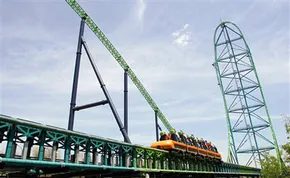
You don’t need salt flats to hit 128 mph. All you need is a hydraulic launch system and a ridiculously tall tower. Kingda Ka at Six Flags Great Adventure in Jackson, New Jersey has the fastest roller coaster in the world. It’s also the tallest.
This track opened in 2005 and is a hydraulically launched rocket coaster. Accelerates from zero to 128 mph in 3.5 seconds. This is not a typo. 3.5 seconds. Your brain doesn’t register the motion until you’re staring at the sky.
The height of the tower is 456 feet. It is made by the Swiss manufacturer Intamin. The shoulder restraint system is used to secure passengers to the seats. This works well. It keeps you from flying out. It does not keep your lunch in your stomach.
There is no guarantee that your digestive system will survive. Just vertical speed and hydraulics.
JCB DIESELMAX: 350 mph tractor
Diesel used to mean slow trucks and smoky buses. Things changed on August 23, 2006. The JCB DIESELMAX averaged 350 mph over two runs at the Bonneville Salt Flats. Driver Andy Green recorded a speed of 365.779 mph on his first pass.
This is not a sports car. It was built by JCB, a British company that typically manufactures backhoes, loaders and construction equipment. They took their diesel know-how and used it for land speed records.
The idea that diesel engines are slow is gone. The JCB DIESELMAX proves that weight reduction and the addition of a streamlined nose cone allow heavy industry to operate faster. Andy Green didn’t just drive. He weaponized it.
Bob Cleveland’s 80 MPH Lawnmower
Most kids hate mowing the lawn. Bob Cleveland loved it so much he drove it 80 mph. On July 4, 2006, Cleveland averaged just over 80 mph on a specially built riding mower at the Bonneville Salt Flats.
He put it together himself. Snapper lawn tractor. 23 horsepower Briggs & Stratton V-twin engine. Modified. custom accessories. It’s not just about speed. It’s a matter of precision.
Cleveland is an eight-time National Lawnmower Racing champion. This is true. This is real sport. He didn’t just build a fast lawnmower. He built a champion.
The fastest lawnmower is still a lawnmower. Just one who doesn’t care about mowing the lawn or suburban etiquette.
Salts Edge
Records include steam, electricity, hydraulics, diesel and gas. These cover different eras of technology. Covers different types of machines. They are all united by the desire to go faster. To push the limits. To break down barriers.
The salt flats is still a testing ground. This number continues to grow. Machines are becoming more and more alien.
What next? Will hydrogen powered cars go 400 miles per hour? A solar car that never stops? Records are being broken. Hobbyists continue to build. The salt dissolves gradually.
The game isn’t over yet. Never.