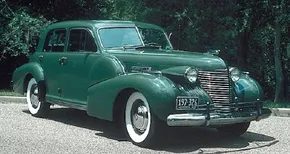
The 1940s were a pivotal decade for Cadillac. This era delivered some of the brand’s most beautiful bodies alongside critical engineering shifts. Like sister division Buick, Cadillac tweaked its design for 1940 and 1941 before unleashing a completely new styling language for the 1942 model year. That redesign left the company in a strong market position once civilian production resumed after World War II.
The 1940 Facelift and Grille Evolution
Most 1940 Cadillacs were remarkably plain. The front ends looked almost like Chevrolets with their simple bar grilles. But there was an exception. The Sixteen stood apart with its eggcrate radiator theme. This design detail first appeared in 1937 and soon became a Cadillac fixture.
All models benefited from sealed-beam headlamps that model year. This upgrade made lighting more reliable across Detroit’s entire lineup.
The Short-Lived Series 72
Ranked below the Series 90 and 75 was the new Series 72. It sat on a 138-inch wheelbase. The lineup offered slightly fewer body styles but lower prices ranging from $2,670 to $3,695.
It was impressive and well designed. Yet it was a one-year-only line. Sales were limited by competition from the more luxurious Series 75. Even counting the 75s and Sixteens, Cadillac built only a little over 2,500 long-wheelbase cars in 1940.
Sixty Special and the Sunshine Turret Top
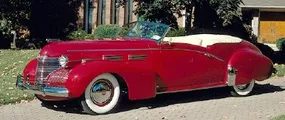
The crisp Sixty Special returned with minor styling tweaks. It kept the same four models offered in 1939. A new option appeared this year. It was a sliding metal sunroof advertised as the “Sunshine Turret Top Roof”.
The ad copy was grand, even if the option was rarely ordered. Cadillac sold only 1,500 of these between 1938 and 1941. It was a manually cranked affair. You could get it on both the standard “town sedan” and division-window Imperial models.
There was also a Sixty Special “town car” version. It featured a painted-metal or leather-covered roof. Just 15 of these were built. Most 1940 Sixty Specials were the standard sedan. Cadillac moved 4,472 of those units.
The Affordable Entry: Series 62
Displacing the Series 61 as the most-affordable 1940s Cadillac was the Series 62. This line became a future Cadillac fixture. Initial offerings included a coupe, touring sedan, convertible coupe, and convertible sedan. All sat on a 129-inch wheelbase.
Prices ranged from $1,685 to $2,195. As in later years, the 62 garnered the most sales by far of any 1940 Cadillac line.
The 1940 V-8 engine was a study in brute-force reliability. Cadillars stuck with a monoblock design, meaning the block and crankcase were cast as one piece. It wasn’t lightweight. It was heavy. But it ran exceptionally smooth.
Three main bearings kept things stable. Counterweights on the crankshaft helped smooth out the vibrations. A two-barrel downdraft carburetor fed the mixture. Performance figures matched the previous year’s tuning. The Series 62 and Sixty Special made 135 horsepower. The larger 72 and 75 models pushed 140. It wasn’t about speed. It was about effortless motion.
The 1941 Cadillac V-8 Overhead Valve Revolution
Then came 1941. And Cadillac changed the game entirely.
They introduced a new overhead valve (OHV) V-8. This wasn’t just a tune-up. It was a complete mechanical overhaul. The pushrod configuration allowed for better airflow. Combustion efficiency jumped. The engine felt more responsive, less sluggish than the older flathead designs.
Why did this matter? Because competitors were still struggling with flathead technology. Cadillac leapfrogged them. The new OHV engine delivered more power with better fuel economy. It set a new standard for luxury sedans.
Wartime Production and Post-War Return
World War II interrupted everything. Production halted. But Cadillac didn’t disappear. They built tanks and aircraft engines. The engineering precision required for war machines fed back into civilian design.
When peace returned in 1946, Cadillac came back with a vengeance. The 1946 and 1947 models were immediate sensations. They retained the sleekness of the pre-war era but refined the lines. The grille changed. The headlights moved. But the core appeal remained the same: supreme comfort and power.
The 1941-1942 models are now considered collector favorites. Their OHV engines are rare and sought after. Restorers fight over original parts. The value has skyrocketed.
Key Specifications and Legacy
- Engine Type: 346 cubic inch V-8
- Configuration: Overhead Valve (OHV)
- Horsepower: 160 hp (1941 model)
- Transmission: Hydra-Matic (introduced later, but standard on many trims by 1940-41 context)
The transition from flathead to OHV was not just an incremental change. It was a declaration of technological leadership. Cadillac proved that luxury could evolve. It could become more efficient. More powerful. More modern.
Other manufacturers followed suit. But Cadillac was first. And that first-mover advantage defined the brand for decades.
What happens when you combine that kind of innovation with post-war optimism? You get the golden age of American cars. The 1946-1947 Cadillars are proof. They look timeless. They drive like dreams.
But we aren’t done yet. The story continues.
Cadillac’s 1941 Reinvention: Luxury, Speed, and the Hydra-Matic Revolution
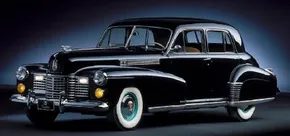
The 1941 model year marked a pivotal shift for Cadillac. The brand made a calculated marketing move to revive the Series 61, effectively replacing the junior LaSalle line. It wasn’t just internal tweaking; this was a direct response to the competitive pressure from Ford’s Lincoln-Zephyr and Packard’s successful One Ten and One Twenty models. The strategy worked. While Packard stuck to medium-priced vehicles well into the post-war era, Cadillac and Lincoln retreated exclusively to the luxury segment. This pivot strengthened their “fine car” reputation and siphoned sales away from their rivals.
Visually, the ’41 Cadillacs looked different. The front fascia featured a complex eggcrate grille with a distinct central bulge that extended down from the hood. Rear styling also evolved, with more prominent taillights. In a move that proved durable, one of these lights concealed the gas filler cap—a feature that would become a staple on Cadillacs for decades.
Wheelbase Reduction and Engineering Shifts
The departure of both the Series Sixteen and the Series 72 significantly simplified Cadillac’s lineup. Wheelbases were consolidated into just three measurements:
– 136 inches for the Series 75
– 139 inches for the four new Series 67 sedans
– 126 inches for all other models
But the visual changes were just the surface. The real mechanical headline was the introduction of the fully shiftless Hydra-Matic Drive. Developed by sister division Oldsmobile, which had debuted the technology a year earlier, this automatic transmission was a first for the luxury class. It remained an option for all Cadillacs through 1949, eventually becoming standard equipment across the entire line.
Performance also saw a boost. Higher compression ratios pushed the V-8 engine to 150 horsepower. When combined with revised axle ratios, most 1941 Cadillacs could hit a genuine 100 mph and accelerate from 0-60 mph in about 14 seconds. For the era, that was impressive.
Sales Boom and Market Impact
The combination of improved performance, the new Hydra-Matic transmission, and a broad price span ranging from $1,345 to $4,045 drove Cadillac production to a new high. Total output for the 1941 model year reached 66,130 cars.
This figure came within approximately 6,700 units of Packard’s total sales. However, the comparison is nuanced. Packard was selling a much higher proportion of less-costly cars. Cadillac’s volume was driven by premium positioning and technological innovation.
Why the 1941 Cadillac Matters
The 1941 Cadillac wasn’t just a yearly update. It was a statement. By adopting the Hydra-Matic transmission and boosting engine output, Cadillac set a new standard for luxury performance. The design changes, from the eggcrate grille to the concealed gas filler, reflected a brand confident in its direction.
While Packard focused on volume in the medium-price segment, Cadillac doubled down on exclusivity. This decision paid off in reputation and sales. The Hydra-Matic transmission, initially an option, would eventually transform the driving experience for luxury car
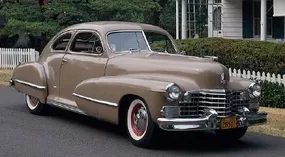
Cadillac’s survival strategy during the late 1930s relied heavily on the revived Series 61. It wasn’t flashy. The trim was simpler. The price tag was lower. Yet it remained every inch a true Cadillac in engineering and stance. Sales numbers reflected that broad appeal.
But the premium models didn’t lag behind. The Series 62 saw dramatic gains. The halo car, the Sixty Special, moved 4,100 units. A new entrant, the Series 63 four-door sedan, attracted nearly 5,000 buyers on its own merit. This wasn’t just volume. It was a reassertion of dominance in the luxury segment.
1942 Design Shifts and Production Halt
The 1942 lineup retained the core structure but adopted a sharper aesthetic. The headline feature was the aggressive, bullet-shaped fenders front and rear. They gave the cars a predatory stance. The Series 62 coupe introduced a “sedanet” variant. This model carried over the fastback roofline established by the 1941 Series 61.
The Sixty Special, however, lost its unique flair. It began to resemble the rest of the Cadillac roster. Less “special” was the verdict. Total production for the year hit 16,511 vehicles. Then came February 1942. War halted civilian manufacturing.
The division didn’t idle. It switched to war production. Tank engines. Aircraft engines. Munitions. This output was vital to the Allied victory. Production continued until V-J Day in 1945.
The 1946 Return: Streamlined and Scarce
Resuming civilian car manufacturing took months of retooling and supply chain restoration. The result for model-year 1946 was a lean 29,194 units. A mere 1,142 of these were built before the calendar year ended. All were Series 62 sedans.
Design changes from 1942 were minimal. The urgency of postwar necessity dictated cuts. The Series 63 was dropped. The Series 67 vanished. Even the division-window Sixty Special model was eliminated from the roster.
The surviving lineup was sparse. Fastback Series 61s remained. Both fastback and notchback Series 62s continued. One iteration of the Sixty Special persisted. And the top-tier Series 75s stayed. Five of them. Regal. Rare. A ghost of the pre-war luxury era.
Why Cadillac Cut Models in 1946
Postwar scarcity wasn’t just about parts. It was about focus. Cadillac couldn’t support the full breadth of its pre-war hierarchy. The Series 63 and Series 67 were casualties of efficiency. The Sixty Special lost its distinctive division-window treatment. This streamlined approach allowed Cadillac to survive the transition without overextending resources.
The Series 62 remained the workhorse. The Sixty Special returned, but stripped of its unique architectural quirks. The Series 75 represented
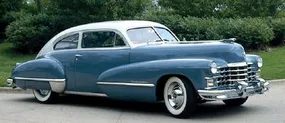
It was a minor update year. A real palate cleanser before the design explosion that followed. But don’t mistake “minor” for “boring.” The 1947 Cadillac was all about refinement. And a few specific visual tweaks that separated the postwar era from the war years.
First, look at the front end. The parking lights went round. Before 1947, they were rectangular. Unless you ordered the massive optional fog lamps, which kept their own distinct housing. Then there’s the grille. They dropped the six-bar theme of the previous year. In its place? A five-bar motif. It looked cleaner. Lighter. More modern.
The fender nameplates lost their block letters. They switched to script. A subtle shift. But one that signaled a move toward elegance. And then you had the wheels. Specifically, the wheelcovers. They were shaped like sombreros. Distinctive. Hard to miss. If you saw that silhouette, you knew it was a Cadillac.
Prices Creep Up, Volume Stays Strong
The economy was messy. Postwar inflation was rampant. Prices for these cars jumped. By $150 to $200. It wasn’t a small amount. But buyers didn’t flinch. They wanted luxury. They wanted status. And they wanted the latest tech.
So production numbers didn’t drop. They recovered. Fast.
Total production for the 1947 model year neared 62,000 units. That’s not a typo. That’s massive recovery. The Series 62 was the volume driver. It accounted for just under 40,000 of those sales. The rest trickled in from the Series 61 and the more opulent Series 75 and 90. But the 62? It was the bread and butter. The entry point for the American dream.
“Galloping postwar inflation swelled prices by $150-$200, but production regained its prewar stride.”
This wasn’t just a car. It was a statement that normalcy had returned. That the factories were humming. That America was back on its feet. And it was rolling down the street in steel and chrome.
What Changed Under the Hood?
Not much. The mechanicals remained largely identical to the 1946 model. The 331 cubic inch V-8 was still the heart of the beast. It produced 160 horsepower. That was solid. Not record-breaking, but reliable. Smooth. The kind of power that lets you pass a truck on a two-lane highway without breaking a sweat.
The transmission? Still the Hydra-Matic. Four-speed automatic. It was a selling point. A luxury feature that set Cadillac apart from every other manufacturer. You didn’t have to clunk through gears. You just set the pedal and let the car do the work. For many buyers, that ease of use was worth the extra cost.
Suspension didn’t change much either. Coil springs up front. Leaf springs in the back. It wasn’t a sports car. It was a cruiser. A tank with leather seats. It absorbed bumps. It glided. If you wanted a car that handled like a race car
The Lockheed Connection and the Birth of the Fin
The 1948 Cadillac didn’t just change the look of American cars. It set a tone that screamed post-war exuberance. It reflected the confidence of a nation that had just survived a global conflict and was ready to spend. But where did the inspiration come from? Look up.
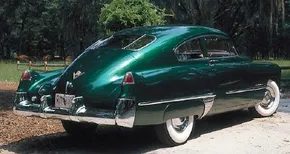
Before World War II, GM designers like Harley Earl, Bill Mitchell, Franklin Q. Hershey, and Art Ross had glimpsed the Lockheed P-38 Lightning. It was a secret pursuit fighter. During the war, a skeleton crew of GM designers played with ideas for postwar styling inspired by some of this airplane’s design elements: pontoon front fenders, pointed nose, cockpitlike curved windshields — and tailfins.
This influence would also be seen at other GM divisions. Olds, for example, adopted the P-38’s engine air-scoop motif for the headlamp bezels on its 1949 “Futuramic” models. But the fin had the most lasting impact. As Mitchell later said: “From a design standpoint, the fins gave definition to the rear of the car for the first time. They made the back end as interesting as the front, and established a longstanding Cadillac-styling hallmark.”
1948 Styling and the Interior Quagmire
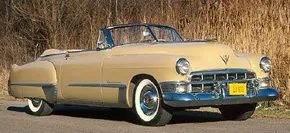
Tailfins were the crowning touch for Cadillac’s masterful 1948 design, which was executed by a small team working under Hershey at his farm in suburban Detroit. The traditional Cadillac grille became more aggressive via larger eggcrates, complemented by a more-shapely hood. Roof and fenderlines were curvaceously beautiful from every angle.
Inside was a new dashboard dominated by a huge “drum” housing gauges and controls. This lasted only a year, however, as it was complex and costly to produce. The ’49s used a simpler instrument board that echoed the grille shape, a theme that would persist for the next eight years.
Models, body styles, and wheelbases stood pat for ’48, though Series 75s wouldn’t get their own redesign until model-year 1950. Low production precluded early amortization of their prewar dies. So, 1948 was a transition year. A stylish one. But not a revolutionary one in terms of mechanics or body codes.
The 1949 Cadillac: Two Major Shifts
After years of research and development, Cadillac introduced two dramatic changes in 1949. We’ll discuss these next.
For more infomation on Cadillac, see:
-
Cadillac: Learn the history of America’s premier luxury car, from 1930s classics to today’s newest Cadillac models.
-
Consumer Guide New Car Reviews and Prices: Road test results, photos, specifications, and prices for 2007 Cadillacs and hundreds of other new cars, trucks, minivans, and SUVs.
-
1930-1939 Cadillac: Cadillac asserts its luxury leadership with magnificent V-16 and V-12 models that were among the greatest cars of an era of great cars.
-
1950-1959 Cadillac: Cadillac symbolizes the optimism of a swaggering America with soaring tailfins and Elvis-era glamour.
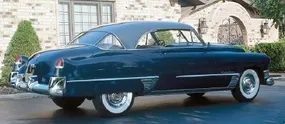
The 1949 Cadillac Coupe de Ville Hardtop
The tailfin wasn’t enough. Cadillac needed to push harder. So for 1949, they dropped two major bombs.
One was the Coupe de Ville. Priced at $3,497, it sat atop the Series 62 lineup. It wasn’t just a new trim level. It was a new body style that changed how Americans viewed cars.
It shared the spotlight with the Oldsmobile 98 Holiday and the Buick Roadmaster Riviera. These three models were the first modern “hardtop convertibles” available from the factory. Before this, you bought a convertible with a soft top. You pulled a button, the roof vanished, and you were exposed. The hardtop kept the metal roof up. But it looked like a convertible when the windows were down.
How did it work?
Simple. There was no central roof post. No B-pillar.
In stylist terms, that means the frame between the front and rear side windows disappeared. Lower the windows, and you get that open-air feeling. No pillars blocking the view. No structural posts interrupting the line. Yet the roof stays fixed. Metal on top. Traditional coupe comfort. Real rigidity.
It was a breezy way to drive without sacrificing structure.
The idea proved enormously popular, starting a trend that would dominate Detroit by the mid-1950s.
Cadillac moved 2,150 units in the first year. That’s a high percentage of their total 1949 production. More than Buick. More than Olds.
The market loved it. Detroit followed.
Cadillac even built one 1949 Coupe de Ville on the 133-inch Sixty Special chassis. Just an experiment. A prototype for what was coming. The rest of the industry couldn’t ignore the trend. By 1955, every major maker had a hardtop.
The 1949 Cadillac OHV V-8: A Weight Reduction Masterpiece
The 1949 Cadillac overhead-valve V-8 wasn’t just an update. It was a sledgehammer to the status quo. For decades, Packard, Lincoln, and Chrysler’s Imperial had held the line on traditional L-head designs. Suddenly, that hierarchy was shattered. This engine was the second punch in a one-two combo that would redefine American performance.
Ed Cole, Jack Gordon, and Harry Barr spent ten years developing this block. Their goal was simple: lighter weight and higher compression ratios. They knew post-war fuels would be cleaner and stronger. So they designed for the future, not the past.
The architecture changed everything. Valves moved overhead. The bore exceeded the stroke. Combustion chambers took on a wedge shape. And then there were the pistons.
Byron Ellis created “slipper” pistons that rode low between the crankshaft counterweights. This allowed for shorter connecting rods. Shorter rods meant less reciprocating mass. Less mass meant the engine could spin faster without shaking itself apart.
How the 1949 Cadillac V-8 Outperformed Larger Engines
Displacement sat at 331 cubic inches. That is smaller than the previous 346 L-head. Yet the new engine produced 160 horsepower. That is 10 horsepower more than its displacement-heavy predecessor. Efficiency won.
The overhead-valve V-8 offered other significant advantages. It remained a cast-iron block, but manufacturing techniques improved during the war years. These advances stripped away excess material. The result was a block that weighed nearly 200 pounds less than the old design.
Compression ratios told the most compelling story. The stock ratio was just 7.5:1. That sounds low by modern standards, but it was a baseline for experimentation. Engineers could push the ratio up to 12:1. The old L-head couldn’t even touch those numbers without melting down.
This flexibility made the Cadillac overhead-valve V-8 a favorite among hot rodders before they even knew the term existed. It was compact. It was strong. It was light.
The engineering logic was undeniable. Short stroke. Light pistons. High compression potential. These weren’t incremental improvements. They were fundamental shifts in how an internal combustion engine could breathe and burn fuel.
Lincoln and Chrysler were left scrambling. Their vertical-valve designs were now obsolete. The race for power had just changed lanes. And Cadillac had already crossed the finish line.
The Proof Was in the Pounding
The OHV V-8 didn’t just offer more torque. It gave you 14 percent better mileage for the same effort. And it was no less durable than its predecessors. In fact, the architecture had plenty of room to grow. Engineers would later stretch it, bore it, and squeeze every last drop of potential from that block.
Consider the numbers. A relatively light 1949-1950 Series 62 could hit 0-60 mph in about 13 seconds. It cleared 100 mph with ease. That is vivid performance by any standard, especially in the early post-war era.
Le Mans and Le Monstre
Briggs Cunningham provided the ultimate proof of this engine’s prowess. He entered a near-stock 1950 Cadillac in the 1950 Le Mans 24-Hour race. Sam and Miles Collier were behind the wheel. They finished 10th overall. No other luxury car has ever matched that achievement at La Sarthe.
They tore down the Mulsanne Straight at around 120 mph. The average speed for the entire race? 81.5 mph. That is a brutal average for a car built to carry families, not endure French endurance racing.
Cunningham didn’t stop there. He drove a streamlined Cadillac-powered special the French dubbed Le Monstre. He went even faster than the Colliers. Then he lost top gear. He still finished right behind them.
The Dynasty Begins
With its brilliant V-8 and best-in-class styling, Cadillac reached the top of the luxury heap by 1950. It would stay there for the next 40 years. The engineering foundation was set. The aesthetic was unmistakable.
To learn why this dominance lasted so long, check out the next installment in our story, Cadillac 1950-1959.
For more information on Cadillac, see:
- Cadillac History : Learn the history of America’s premier luxury car, from 1930s classics to today’s newest Cadillac models.
- Consumer Guide Reviews : Road test results, photos, specifications, and prices for 2007 Cadillacs and hundreds of other new cars, trucks, minivans, and SUVs.
- 1930-1939 Cadillac : Cadillac asserts its luxury leadership with magnificent V-16 and V-12 models that were among the greatest cars of an era of great cars.
- 1950-1959 Cadillac : Cadillac symbolizes the optimism of a swaggering America with soaring tailfins and Elvis-era glamour.