If you have ever towed a trailer, you know the feeling. The rearview mirror shows the load bouncing. Your stomach drops. You wonder if the next gust of wind or sudden lane change will spin the whole setup into a barrier. It is a specific kind of panic that keeps most drivers up at night. There is a mechanical fix for this. It is called a weight distribution system.
These systems are not optional accessories for serious towing. They are essential engineering tools for safety and control. Especially when you are pulling a heavy load, understanding how they work separates the informed driver from the one waiting for an insurance adjuster.
The Two Numbers That Matter
To understand the mechanics, you need to know two specific metrics. They are the foundation of safe towing.
Gross Trailer Weight (GTW) is straightforward. It is the total weight of the trailer. This includes the steel itself. It includes the cargo. It includes the fuel in the trailer’s tanks. It includes every bag, tool, and piece of furniture you have loaded.
Tongue Weight (TW) is the tricky part. This is the downward force exerted on the hitch ball. It is generally 10 to 15 percent of the GTW. But it is not just the front of the trailer. Any weight placed behind the rear axle of the tow vehicle adds to this number. If you load the trunk of your SUV or the bed of your pickup truck with heavy gear, that pressure transfers directly to the hitch. You must factor that in.
Finding the delicate balance between tongue weight and gross trailer weight is not just a suggestion. It is a requirement for keeping your wheels on the pavement.
The Physics of Failure
Why does this balance matter? Because gravity and leverage are unforgiving.
When you have too much tongue weight, the rear of the tow vehicle sinks. We call this “diving.” The front axle of the car lifts off the ground. This is catastrophic for braking. Your front brakes provide the majority of stopping power. If those wheels are in the air, you are braking on a two-wheel vehicle. Steering becomes light and disconnected. You lose traction exactly when you need it most.
The opposite problem is just as deadly. Too little tongue weight creates instability. The trailer becomes a lever. It starts to sway. This is not a gentle wobble. It is a violent oscillation. The trailer swings side-to-side. It can jackknife. It can flip. It can take your vehicle down with it.
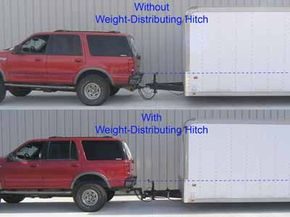
Weight distribution hitches solve this. They transfer a portion of the tongue weight back to the front axle of the tow vehicle. They also spread the load across the trailer’s own axles. The result is a level platform. The tow vehicle sits upright. The trailer tracks straight.
Why It Matters for Handling
The benefits go beyond just stopping the sway. A properly set up weight distribution system improves the entire driving dynamic.
Braking is more efficient. The front tires maintain contact with the road, providing the grip needed to stop in a straight line. Steering response becomes predictable. The vehicle does not feel like it is dragging a dead weight behind it. It feels connected.
This is particularly important for large loads. A 5,000-pound travel trailer behaves differently than a 2,000-pound utility trailer. The leverage forces are exponentially higher. Without distribution, even a skilled driver can be overwhelmed by physics. With it, the vehicle manages the load.
The Mechanics of the Fix
So how does the hardware actually work? It is not magic. It is simple leverage.
Gross trailer weight and tongue weight are the numbers that dictate whether your tow setup stays on the road or ends up in a ditch. Add more mass to the equation, and the physics get hostile. A weight distribution system doesn’t magically boost your vehicle’s maximum towing capacity. It can’t. But it does improve handling by shuffling some of that tongue weight off the rear bumper and redistributing it across the axles. This lets you safely approach your vehicle’s limits without losing control.
Think back to the trouble caused by improper tongue weight. With a standard weight-carrying hitch, you’re walking a tightrope. Too much weight on the tongue and the front end lifts. Too little and the sway starts. There is no buffer.
When you add a weight distribution system, the rules shift slightly but the stakes remain high. You still need to respect the ratio between tongue weight and gross trailer weight. However, heavier loads demand more precision. The system uses leverage to take pressure off the tow vehicle’s rear axle and push it forward onto the front axle. It also spreads load onto the trailer’s axles. The result? The vehicle sits level. Handling improves. Stability returns.
Every axle on your tow rig has a Gross Axle Weight Rating (GAWR). Adjusting the weight distribution system ensures you don’t exceed these limits. It balances the load so no single axle is overloaded.
For lighter trailers, a weight-carrying hitch is often sufficient. But as the scales creep up, a weight distribution hitch becomes necessary. If your trailer weighs more than 50% of the towing vehicle’s weight, you likely need one. Legal requirements also kick in at certain gross trailer weights. So which setup do you actually need?
How Weight Distribution Systems Fix Towing Dynamics
The core problem with heavy towing is the rear squat. When you hitch up a trailer, a significant portion of the load rests on the tongue. This pushes down on the rear bumper of the tow vehicle. The suspension compresses. The front end lifts up. Steering becomes vague. Braking distance increases.
A weight distribution system solves this by using spring bars to transfer tongue weight to the trailer axles and the front axle of the tow vehicle.
- Rear Axle Relief: Reduces compression on the rear suspension.
- Front Axle Load: Adds pressure to the front axle, restoring steering control.
- Trailer Axle Load: Increases tire traction on the trailer axles.
This redistribution keeps the vehicle level. It doesn’t just look better. It directly impacts safety.
When Is a Weight Distribution Hitch Required?
Most manufacturers and state laws require a weight distribution hitch when specific thresholds are crossed.
- Trailer Weight: If the gross trailer weight exceeds 5,000 lbs, a weight distribution hitch is often mandated.
- Weight Ratio: If the trailer weighs more than 50% of the tow vehicle’s weight.
- Sway Issues: If the trailer is prone to sway or if the tow vehicle struggles to keep the trailer straight.
Ignoring these guidelines can lead to dangerous handling characteristics. Overloading the rear axle can cause brake fade. Lifting the front end reduces steering response.
Choosing the Right System
Not all weight distribution systems are created equal. They differ in capacity, design, and ease of use.
- Capacity Rating: Ensure the system is rated for your trailer’s tongue weight.
- Spring Bar Type: Dual-cam systems offer more sway control than single-cam systems.
- Adjustability: Look for systems that allow for easy height adjustment.
Understanding these factors helps you choose the right setup. But
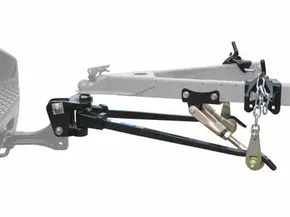
The first rule of buying a weight distribution hitch is to look at the numbers. Specifically, you need to know two things: the gross trailer weight (GTW) and the tongue weight (TW). Most systems list both ratings. You need a setup where both numbers sit comfortably above your actual load.
Don’t overbuy.
If you pick a system rated for a 1,000-pound tongue weight but your trailer only carries 300 pounds of tongue weight, you have a problem. Add another 50 pounds of cargo in your tow vehicle’s trunk and you are nearly 650 pounds under the system’s capacity. The bars won’t engage properly. The result? Unpredictable handling. Dangerous handling.
On the flip side, if you try to distribute 1,500 pounds of tongue weight on a 1,000-pound rated system, you are overloading the components. The bars can’t transfer the load effectively. Your rear suspension collapses. You lose steering control.
Think of The Price Is Right. You want to bid the closest number without going over. Hit the target.
Round Bars vs. Trunnion Bars
Once you have the capacity sorted, you face a hardware choice: round bars or trunnion bars.
Round bars are cylindrical. They are easier to maneuver when hooking up the trailer. The clearance is better. You won’t bang the shank against the coupler.
Trunnion bars have a square or rectangular profile that fits into a bracket on the hitch head. They generally allow for higher weight ratings. The connection is more rigid.
There is no universal winner. A heavy-duty pickup might benefit from the rigidity of trunnion bars. A lighter setup with tight storage constraints might prefer the ease of round bars. Check your specific setup. Talk to an experienced installer. The right choice depends on your vehicle and trailer combination.
To Sway Control or Not to Sway Control?
Many modern weight distribution systems come with integrated sway control. Some don’t. You might be tempted to splurge on the two-in-one unit immediately. You probably don’t need to.
Weight distribution hitches naturally reduce sway by leveling the tow vehicle and trailer. This reduces the pendulum effect that causes fishtailing. For many drivers, the standard system is enough.
Only add a separate sway control system if you have a problem.
If you are still experiencing sway, check your packing first. Is your cargo distributed evenly? Are you overpacking the rear of the trailer? Then check your speed. Driving too fast with a heavy load invites oscillation.
If the packing and speed are correct and you still have sway, then add a dedicated control unit. Do not pay for a feature you do not need. Start simple. Upgrade only if necessary.
How They Actually Work
Before we get to the installation steps, it helps to understand the mechanics. A weight distribution system is essentially a lever.
The spring bars are tensioned when the trailer is backed onto the hitch ball. This tension lifts the rear of the tow vehicle. It pushes down on the front axle. It transfers some of the tongue weight to the trailer’s axles.
This leveling improves steering. It restores visibility. It keeps the tires planted.
The next step is getting that tension into the system. That is where the hardware meets the road.
How Weight Distribution Hitches Actually Work
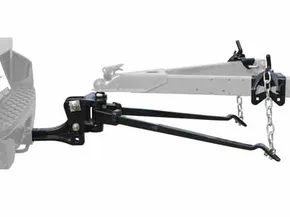
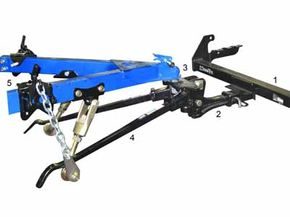
Most trailer hitches feature a 2-inch receiver and the weight distribution system can be inserted directly into that. The first part you’ll install is called a shank. These usually plug into the receiver and can be turned in an upward or downward direction, due to the fact that when both vehicles are level, one is often lower or higher than the other. A head assembly is mounted onto the shank, and it provides both the platform for the hitch ball and the spring bars. At this point, the trailer can be re-hitched to the towing vehicle.
Once the vehicles are back together, we can continue installing the weight distribution system. In most systems, the setup basically works like this. Spring bars (remember either round bars or trunnion bars) run from the head assembly to a pair of chains. These chains hang down below the trailer from a set of brackets and attach to them in a way that creates tension along the spring bars. As the tongue weight pushes the bars down, the chains pull the bars up. In order to straighten out to their natural positions, the spring bars push up on the head assembly, distributing the weight among the axles.
The next step in the process is usually to attach the chains to the spring bars and insert the bars into the head assembly. Then the brackets are mounted on the trailer and the chains are attached to those, often with a lift lock. The brackets should be lined up with the ends of the bars, and you generally want at least five chain links showing.
There are two main elements to keep in mind during the installation process. The first is the change in the height of the wheel well rims of the two vehicles. You’ll want to measure them before, during and after installation to make sure the weight distribution system is spreading the weight evenly and appropriately. The second aspect is the angle of the bars — they should run parallel to the tongue of the trailer or downwards towards the ground, and often the head assembly can be tilted to accommodate this or the amount of chain links can be adjusted.
Some systems (especially those that also offer enhanced sway control) may use slight variations, such as a pair of L-shaped brackets in place of the chains, but the systems work in similar ways. Just remember that it’s a very good idea to get a professional to help you determine what weight distribution system will work best for you, and to follow the instructions carefully while you’re installing it. Once you’re ready to ride, get lots more great transportation links on the next page.
Weight Distribution Hitch FAQ
How does a weight distributing hitch work?
A weight distribution hitch distributes the total weight of the trailer, including cargo, fuel and anything else in the truck, to the vehicle’s and trailer’s axles, relieving the vehicle’s bumper for increased safety and maneuverability.
What is the purpose of a weight distribution hitch?
The primary purpose of a weight distribution hitch is to prevent dangerous conditions like the trailer swinging or losing the ability to brake, steer, turn and maintain control of the trailer.
How do you set up a weight distributing hitch?
First, you install a shank that plugs into the receiver. A head assembly is then mounted onto the shank, which provides the platform for the hitch ball and spring bars. The next step is to attach the chains to the spring bars and insert the bars into the head assembly. Then, the brackets are mounted on the trailer and the chains are attached to them usually with a lift lock. Make sure that the brackets are lined up with the ends of the bars.
Can I tow more with a weight distribution hitch?
No, it doesn’t increase your vehicle towing capacity. As a standard rule, if your trailer weighs more than half of your tow vehicle, you have to use a weight-distribution hitch.
Can you back up with a weight distribution hitch?
While you can backup with a weight distribution hitch, it is important to be careful when doing so. Before backing up, make sure that you have disengaged the sway control.
The Boring Stuff You Actually Need to Read
Skip the fluff. If you want to understand the mechanics behind the tow, the real learning happens in the details.
“Trailer sway is dangerous, be careful.”
— Mark Polk, RV Tech Tips
This isn’t just advice. It’s a warning. Sway kills. It happens when weight distribution fails. Or when you ignore physics.
Where to Look for Real Answers
You don’t need a degree in automotive engineering. You need reliable sources.
- National Highway Traffic Safety Administration (NHTSA) : They publish the raw data on towing safety. Their 2002 guide on “Towing a Trailer: Being Equipped for Safety” is old but foundational. It covers equipment standards that haven’t changed much.
- U-Haul Towing Glossary : If you’re confused by terms like “drop ring” or “load leveler,” start here.
- etrailer.com : They answer the specific questions people actually ask. “How does weight distribution work?” “Why does my truck sag?” Their FAQs cut through marketing speak.
- DrawTite & Equal-i-zer : Manufacturers post installation guides. These are technical, yes. But they show you exactly how the hardware connects to your frame.
The Core Concepts
You can’t tow safely without knowing these.
Weight distribution isn’t magic. It’s leverage. When you load a trailer, the tongue weight pushes down on the hitch. This lifts the front of your tow vehicle. Steering gets light. The rear squats.
A weight distributing hitch fixes this. It uses spring bars to transfer tongue weight to the trailer axles and the front axle of the tow vehicle. Balance returns. Tires wear evenly.
Sway control is the other half. Even with perfect weight distribution, a sudden gust or a passing truck can trigger oscillation. Sway control systems (friction or friction-less) dampen this motion. Without them, you’re playing Russian roulette with a 5,000-pound box.
Specific Resources for Deep Dives
- Martin, Joe (Sherline Products) : “Trailer Loading and Towing Guide.” Focuses on load placement. Center of gravity matters.
- Polk, Mark : “Trailer sway is dangerous.” Breaks down the physics of oscillation. Why it starts. Why it escalates.
- NHTSA : Federal standards for equipment. What’s legal. What’s safe.
- Motor Era Dictionary : Quick reference for jargon. “Fifth wheel,” “gooseneck,” “tongue weight.” Know the terms before you buy the gear.
The Unwritten Rules
- Check your tires. Both the truck and the trailer. Under-inflation causes heat. Heat causes blowouts.
- Inspect your hitch. Daily. Before every trip. Look for cracks. Check bolt torque.
- Know your limits. Your vehicle’s Gross Combined Weight Rating (GCWR) is not a suggestion. It’s a hard ceiling.
Final Thoughts
There’s no shortcut. You read. You learn. You check.
The resources listed above are where the real knowledge lives. Not in the flashy ads. In the technical manuals. In the safety guidelines.
Start with the NHTSA. Then move