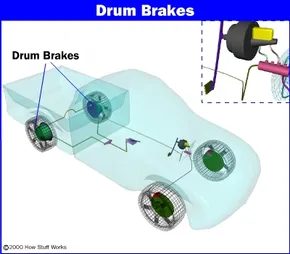
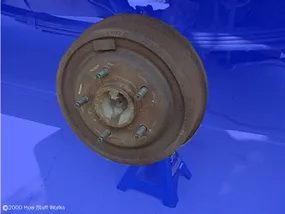
Shoes press against a spinning surface. That is the fundamental physics behind both disc and drum brakes. In the latter case, that surface is a hollow, cast-iron cylinder known as a drum.
Most vehicles still utilize this older technology on the rear axle while reserving disc brakes for the front. Why? Cost. Manufacturing a drum brake assembly is cheaper. It’s also simpler to integrate the parking brake mechanism directly into the drum itself. But there is a tradeoff. More moving parts. More complexity. And consequently, more work when you need to service them.
We are peeling back the layers of this mechanical puzzle. We will look at the exact mechanics of how drum brake systems generate stopping power. We will examine the emergency brake setup that lives inside the drum. And we will figure out what kind of maintenance these neglected rear wheels actually require.
The Anatomy of a Drum
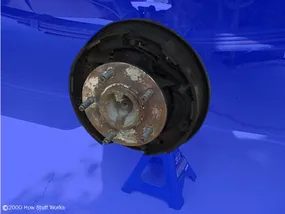
Inside the drum, you will find a set of curved brake shoes. These are lined with friction material. A wheel cylinder sits at the top. When you press the pedal, hydraulic pressure forces the pistons in the wheel cylinder outward. This pushes the shoes against the inner wall of the rotating drum.
The friction slows the drum. Which slows the wheel. Which slows the car. Simple. But the self-servo effect adds a layer of complexity. As the drum rotates, it drags the leading shoe deeper into contact with the surface. This amplifies the braking force. It makes the brake more effective. It also makes it prone to grabbing if the adjustment is off.
The Parking Brake Connection
Here is where rear drums earn their keep. You do not need a separate cable-actuated caliper for the parking brake. The same shoes that stop the car can lock it in place. A mechanical link pulls the shoes apart further than the hydraulic system ever would. This provides a reliable, fail-safe hold. It works even if your hydraulic lines burst. That is a significant safety margin.
Disc brakes can do this too. But it requires additional hardware. More parts. More potential points of failure. The drum keeps things contained. And contained means cheaper to produce.
Maintenance Realities
Servicing drum brakes is not for the faint of heart. You have to remove the wheel. Then the drum. Which often means dealing with rust. Then you have to disassemble the brake assembly. Clean the backing plate. Inspect the wheel cylinder for leaks. Replace the shoes. And replace the hardware. The springs. The retainers.
Most people ignore this until the brakes fail. Or the parking brake slips. By then, the components are worn. The drums are scored. You might need to machine them. Or replace them. It is a labor-intensive process. But it is also a reliable one. Provided you keep up with it.
There is a reason these brakes still exist in an era of ABS and electronic stability control. They work. They are cheap. And they keep your car from rolling away on a steep hill. But they demand respect. And regular attention.
Why the Rear?
You might wonder why manufacturers didn’t just put discs on all four wheels. Weight. Cost. Complexity. Drums are heavier. But they are also smaller. And they hide the parking brake mechanism neatly inside. For economy cars and entry-level models, that packaging advantage is hard
The hardware underneath the skin
You are looking at the Nissan Skyline GT-R BN40, specifically the 1999-2002 model years. This is the era where the GT-R stopped trying to be a luxury grand tourer and started acting like a track weapon. The RB26DETT engine is air-cooled. Yes, air-cooled. The intercoolers are mounted in the front bumper, not the roof. This is different from the earlier BCNR32 or BN34 models which had their intercoolers on top of the engine. Why does this matter? Because heat management changed. The front-mount setup allows for better airflow at speed, but it makes the car vulnerable to debris and crash damage.
The ATTESA E-TS all-wheel-drive system is rear-biased. Default is 60% rear, 40% front. Under hard acceleration or slip, torque shifts forward. It uses a mechanical viscous coupling and an active yaw control system in later models. The 1999-2002 R34 GT-Rs often came with the Brembo four-piston calipers. The rotors are cross-drilled. The suspension is a double-wishbone setup all around. The rear uses a multi-link design. This geometry allows for better camber control during cornering than the MacPherson strut setups found on lesser Skyline trims.
The electronic brain
The ECU in these cars is not just a timer. It controls ignition timing, fuel injection, and the Super HICAS rear steering system. The Super HICAS is a hydraulic system. It uses a valve controlled by the ECU to steer the rear wheels slightly. At low speeds, it turns opposite to the front wheels to tighten the turning radius. At high speeds, it turns in the same direction to stabilize the car. The 1999-2002 models introduced a digital version of this system. It is faster. It reacts quicker to slip. The sensors in the rear subframe detect yaw rate. The ECU calculates the necessary correction.
The instrument cluster has a G-Meter. This is not a simple accelerometer. It measures lateral and longitudinal G-forces. The needles move in real-time. This helps you understand how much load the chassis is taking. It also helps you tune your driving. If you hit a high G-value in a corner, you know you are close to the limit. You can adjust your inputs accordingly. The digital speedometer is accurate to within 10 km/h at higher speeds. The tachometer redlines at 8,000 RPM. The RB26DETT makes its peak power at 6,800 RPM. The peak torque is at 4,400 RPM.
Common failure points
The oil cooler lines are prone to failure. They are rubber hoses. Over time, they crack. Oil leaks onto the belt. This is a fire hazard. Replace them with stainless steel braided lines. The fuel injectors can clog. The RB26DETT has direct injection? No. It is port injection. But the fuel pressure regulator can fail. Symptoms include hard starting and rough idling. Check the fuel pressure. It should be 3.5 bar